Why Medical Monitors Keep Using Silicone Keypads Over Touchscreens
- Share
- publisher
- Suey
- Issue Time
- Aug 27,2026
Summary
Why medical monitors keep using silicone keypads over touchscreens: glove operation, disinfectant compatibility, tactile alarm handling and reliability - and when a hybrid design is the right call.
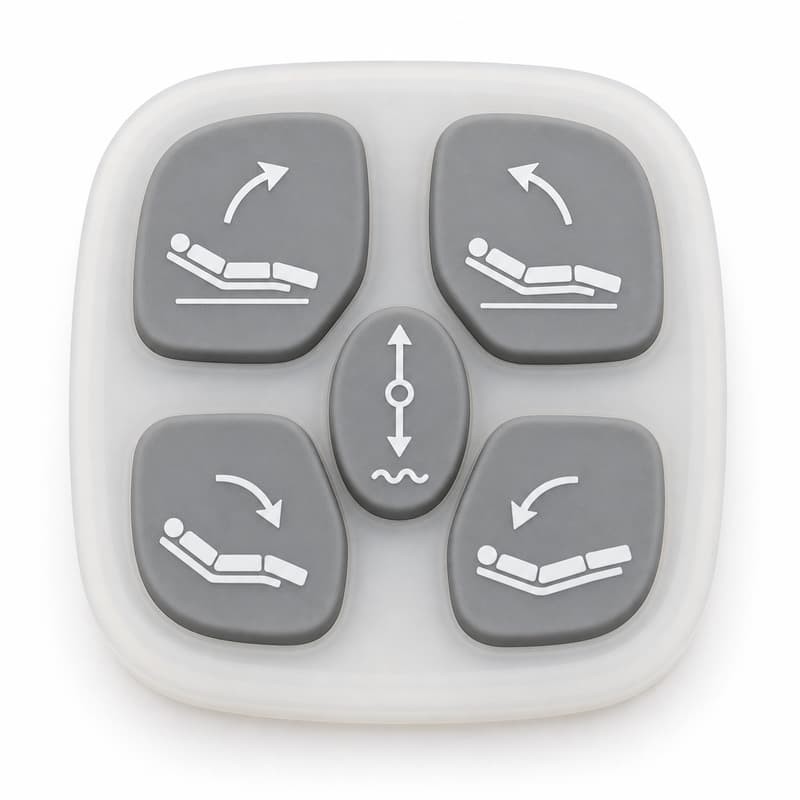
Medical Device Input Design
In an era of touchscreen-everything, most patient monitors, infusion pumps, defibrillators, and bedside vital-signs displays still ship with silicone keypads. That is not conservatism - it is engineering judgment under constraints that consumer electronics never face: gloved and wet hands, disinfection chemicals, extreme reliability requirements, and operators who must interact without looking. This article explains why medical monitors keep using silicone keypads over touchscreens, where each technology genuinely wins, and how to specify a medical-grade silicone keypad when the decision is yours.
1. Medical Monitor Input: Touchscreen vs Silicone Keypad
The comparison between touchscreens and silicone keypads on medical monitors is not about which is newer; it is about which meets the clinical requirements with acceptable risk. A patient monitor is used by nurses wearing gloves, sometimes wet, in a room where the screen may be smeared with cleaning agents, and where a missed key press during an alarm event has real consequences. Capacitive touchscreens depend on skin capacitance - which gloves disrupt - and require visual confirmation, because a touch gives no tactile event. A silicone keypad gives a positive tactile snap, works through any glove material, and its physical layout can be operated by muscle memory. Our earlier analysis of touchscreen failures in industrial environments documents the same physics on the factory floor.
The decision matrix is straightforward. Use a touchscreen when the primary task is viewing dense waveforms or adjusting graphical settings with a stylus or bare finger. Use a silicone keypad when the task is a small set of high-frequency, must-not-fail actions - start, stop, alarm acknowledge, parameter selection - especially in emergency contexts. Most medical monitors end up hybrid: a touchscreen for the display, a silicone keypad for the critical controls. The reasons behind that split are the subject of the rest of this article.
2. Gloved Hands and Infection Control: Why Silicone Keypads Fit Clinical Workflows
Infection control is not a niche requirement for medical monitors; it is a regulatory and practical necessity. Touchscreens have a fundamental tension with disinfection: aggressive chemicals degrade oleophobic coatings and can cloud the glass, and screens collect fingerprints that become a visual and hygienic issue between cleanings. A silicone keypad is a sealed, non-porous surface that survives repeated wiping with alcohol, quaternary ammonium compounds, and even bleach-based wipes. Medical-grade silicone keypads are routinely validated against the disinfectant regimens of the hospital environment, with the legend system chosen to survive those chemicals.
Gloved operation is the second clinical constraint. A capacitive touchscreen is unreliable with nitrile or latex gloves, especially when the glove is wet or the user is under time pressure; resistive screens need pressure that gloves provide but wear out mechanically. A silicone keypad switches through the glove with a force of 150–250 gF, which a clinician applies without thinking. The tactile snap also confirms the press - the operator never has to look away from the patient to verify that the alarm was acknowledged. Designers who specify medical keypads should also check the actuation force against gloved thumbs and against the disinfectant compatibility of the legend process, both of which are part of our spec-sheet versus real-world-use review.
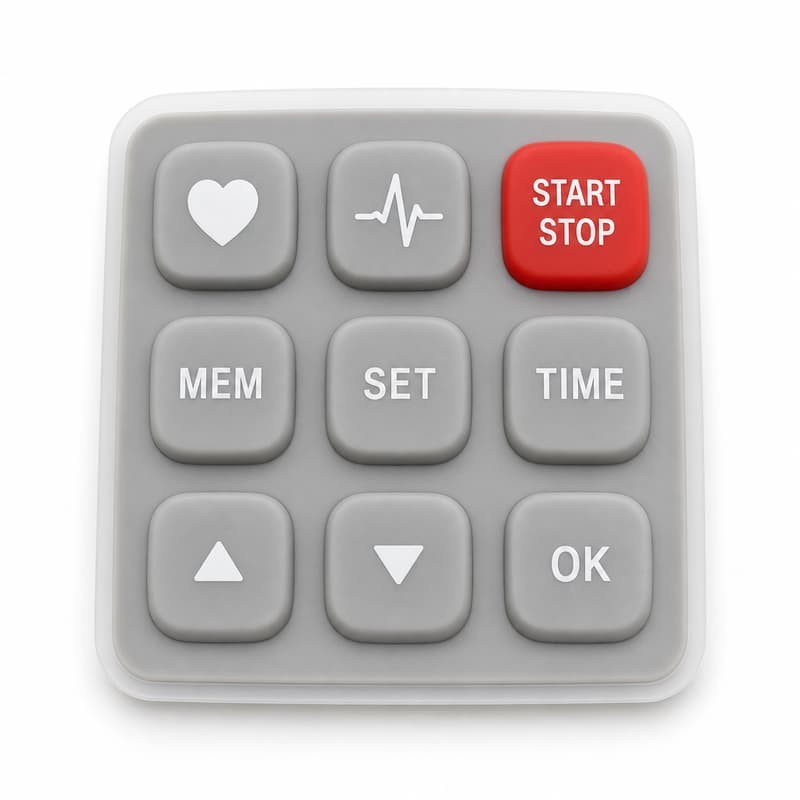
3. Reliability When It Counts: Silicone Keypads on Medical Monitors
A patient monitor is a life-supporting display: the input path must not be the component that fails. Silicone keypads have no moving electrical contacts exposed to the environment - the carbon pill or gold dome contact is sealed inside the keypad assembly - and no glass that can crack, no coating that can delaminate, and no firmware touch calibration that can drift. Their dominant failure mode is mechanical wear, which is predictable and testable: a well-specified keypad is rated for 500,000 to 5 million actuations per key, and the acceptance criteria (contact resistance, actuation force drift) can be written into the drawing.
- Drop and shock resistance. A monitor wheeled between rooms or dropped from a cart keeps its keypad; a cracked touchscreen takes the whole device out of service.
- Battery and dry-circuit operation. Medical monitors scan keys at microamp levels. A carbon pill keypad with gold-plated pads switches reliably in dry circuits; specifying the contact system for the actual scan voltage matters.
- No ghost input. A touchscreen can register a palm or a droplet as input; a silicone keypad only registers a deliberate press above its actuation force. In an alarm-management context, false input is a patient-safety issue.
The durability argument - including how the 50,000-cycle figure commonly cited for keypads undersells what a properly specified keypad delivers - is developed in our article The 50,000-Cycle Myth.
4. Tactile Confirmation and Alarm Handling in High-Stress Care
In a cardiac arrest or a deteriorating-patient alarm, the clinician does not look at the monitor while pressing. They press by location and feel. This is the strongest argument for the silicone keypad on medical monitors: the layout is fixed, physical, and learnable, and the tactile snap confirms the action. Emergency stop, alarm silence, and defibrillation charge controls are muscle-memory targets; moving them to a flat glass surface forces a visual confirmation loop that costs time and concentration.
Clinical ergonomics principle: the more critical and time-pressured the action, the more it should be a physical, tactile, fixed-position control. This is why defibrillator and monitor manufacturers keep physical keys for the highest-criticality functions even on flagship touchscreen devices.
The legend and layout design should follow the same logic: high-contrast, color-coded critical keys (red for emergency functions), raised tactile rings or spacing around the alarm cluster, and legends validated for low-light use. Our case for the rubber keypad in instrument design describes how tactile feel, sealing and reliability translate directly into the product's clinical reputation.
5. Case Study: An ICU Monitor OEM That Kept Its Silicone Keypad
A critical-care monitor manufacturer approached FromRubber during a mid-life redesign. The product roadmap proposed a full touchscreen interface to modernize the look; the clinical team pushed back, citing alarm-acknowledge errors during code events and glove usability complaints from two hospital pilots. The OEM's engineering team was split between "modern" and "clinical."
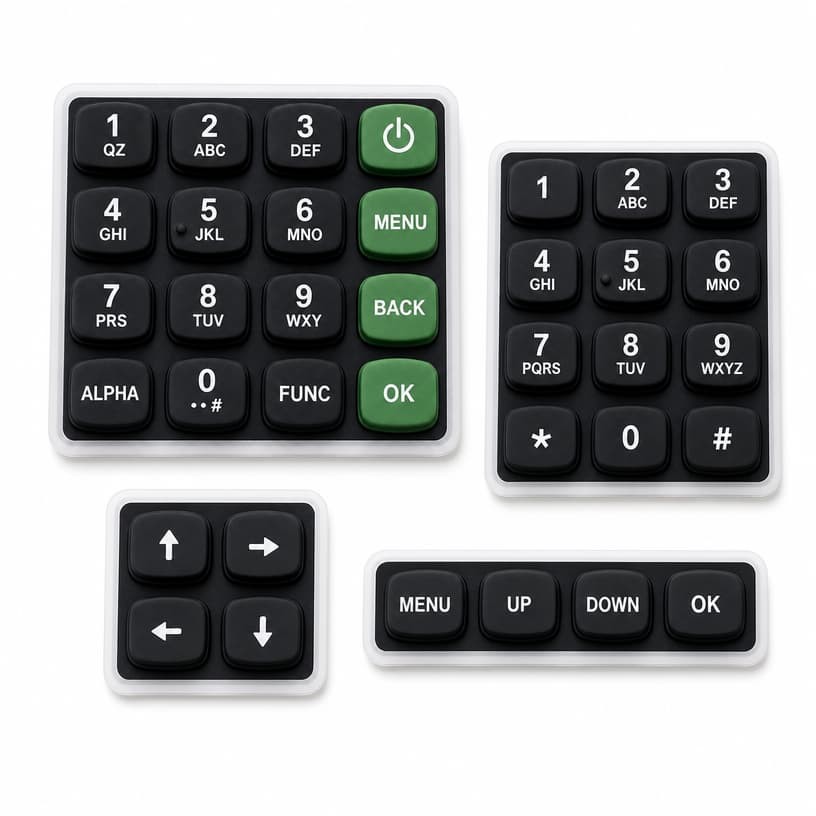
We supported the clinical side with data: a usability fixture comparing alarm-acknowledge task time between a touchscreen mock and a silicone keypad mock, measured with nitrile gloves and under simulated alarm noise. The keypad mock was consistently 0.4–0.8 seconds faster per interaction and produced zero double-press errors, against 2–4% on the touchscreen mock. The OEM kept a hybrid design - touchscreen for waveform review, silicone keypad for the critical control cluster - and re-specified the keypad with laser-etched legends, 220 gF actuation, and a UV-stable, disinfectant-compatible compound.
The revised keypad passed 1 million actuations per key with contact resistance below 200 Ω and no legend loss after 10,000 disinfectant wipe cycles. The hybrid approach also reduced touchscreen replacement costs, since the highest-frequency controls no longer wore out the display. The same full-chain discipline - fixture testing, material validation, and cycle testing - is described in our instrument-grade keypad reliability guide.
6. Specifying a Medical-Grade Silicone Keypad: What Designers Should Ask
Confirm the disinfectant list and the wipe-cycle count, then validate the legend and surface against them
Specify actuation force and travel for gloved operation, and confirm force retention after 500k+ cycles
Choose the contact system for the monitor's dry-circuit scan voltage (carbon pill + ENIG is the standard)
Define the sealing class (IP rating) and the keypad-to-housing seal for fluid resistance
Request material documentation: biocompatibility data (ISO 10993 / USP Class VI) if the keypad contacts patients or staff
Fix the critical-key layout and color convention before tooling, and validate with clinical users
Medical device regulation adds documentation requirements but does not change the underlying engineering: a silicone keypad is one of the few input technologies that can be fully specified, tested and validated up front. Laboratory instrument designers face the same trade-offs; our article on failure modes in laboratory instrument keypads shows how the same specification discipline prevents the most common field failures.
Sources and Further Reading
The clinical and engineering arguments in this article draw on published industry material: USP - Class VI Biocompatibility Testing, ISO 10993 - Biological Evaluation of Medical Devices, and Shin-Etsu - Silicone Contact Elements for Keypads. Usability measurements and engineering estimates reflect FromRubber project records for medical device keypad programs. Related reading: when touchscreens fail, the rubber keypad's underestimated role, and the Silicone Keypad Technology Sharing series.
About FromRubber - FromRubber is a full-process silicone keypad manufacturer for medical devices and laboratory instruments, with in-house tooling, molding, printing, backlighting and environmental testing. We regularly support medical OEMs with material documentation, disinfectant compatibility validation and cycle testing for keypad qualification. If you are comparing input technologies for a monitor or instrument, our engineering team can build the same usability fixtures and material data packages described in this article.