Why Your Industrial Panel Buttons Feel Different in Winter?
- Share
- Issue Time
- Sep 7,2026
Summary
Industrial panel buttons stiffen in winter because modulus rises, recovery slows, and the housing shrinks differently - not because silicone freezes. What to test and specify so the feel holds at -20 C.
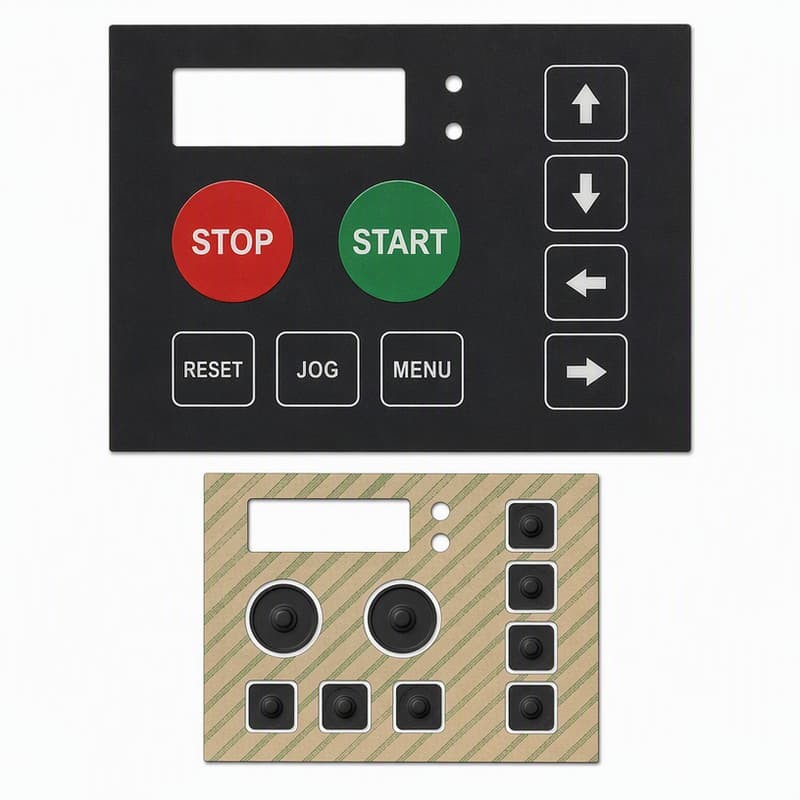
Every November, the same ticket lands on the bench. The control panel is indoors. Nothing was changed. But the buttons feel stiff, the return is slow, and one or two keys only register on the second press. The unit sits near a loading-bay door, or in an unheated workshop, or on a machine that runs chilled lines. The calendar did this, not the operator.
Most engineers file this under "cold makes rubber hard" and move on. The explanation is true and useless. Silicone does not freeze at winter temperatures: its glass transition sits near −120 °C, so the material never enters a glassy state anywhere a control panel runs [1]. If the buttons changed, something else changed with the temperature. Unless you find out what, you will fix the wrong variable, and the same tickets will come back next November.
The button that gets stiffer while the material stays flexible
Measure a silicone pad on a dynamic mechanical analyzer and you will see it: the storage modulus of silicone rubber rises as the temperature falls, long before any glass transition. Published data for PDMS-based elastomers show storage modulus in the range of 1–10 MPa at −100 °C versus roughly 0.1–2 MPa at 25 °C [1]. The chain segments slow down; the same web deflection simply needs more force.
On a real keypad this is not a laboratory curiosity. The actuation force is set by web geometry and durometer at room temperature, and most industrial panels are tuned at 25 °C. Put that part at −20 °C and the measured peak force on the same tool can climb by 25–40%. Operators do not read force curves; they read "this button got hard."
The return that got slower: a rate problem, not a set problem
The second winter complaint is the slow return — the key goes down and comes back "lazily." This is usually blamed on compression set, and that is the wrong diagnosis. Compression set at elevated temperature (ASTM D395, ISO 815-1) tells you whether the rubber has permanently lost height. That is a hot problem, not a cold one.
Cold produces a different behavior: recovery becomes rate-limited. The rubber wants to spring back, but at low temperature the relaxation simply takes longer. ISO 815-2 exists precisely for this — compression set determined at low temperatures, with recovery measured at the test temperature [2]. A dome that recovers in 40 ms at 25 °C may take several times longer at −20 °C. To a finger that reads as "sticky," and on a fast operator panel it can mean missed second presses.
The click that disappeared
Tactile feel is not a hardness number; it is the shape of the force-travel curve. Keypad design guides consistently target a peak actuation force around 125–150 g with a snap ratio (return force divided by peak force) of 40–60% [3]. Drop the snap ratio below roughly 30% and the key stops feeling like a switch — it feels linear, mushy, "like pressing a sticker."
Temperature does not scale the whole curve evenly. Peak force rises with modulus, but the return force is governed by the geometry snapping back, and it does not rise by the same proportion. The result is a winter snap ratio that collapses even though nothing is broken. The user says "the click is gone." What actually happened is the two halves of the force curve moved apart.
The housing that shrinks at a different rate
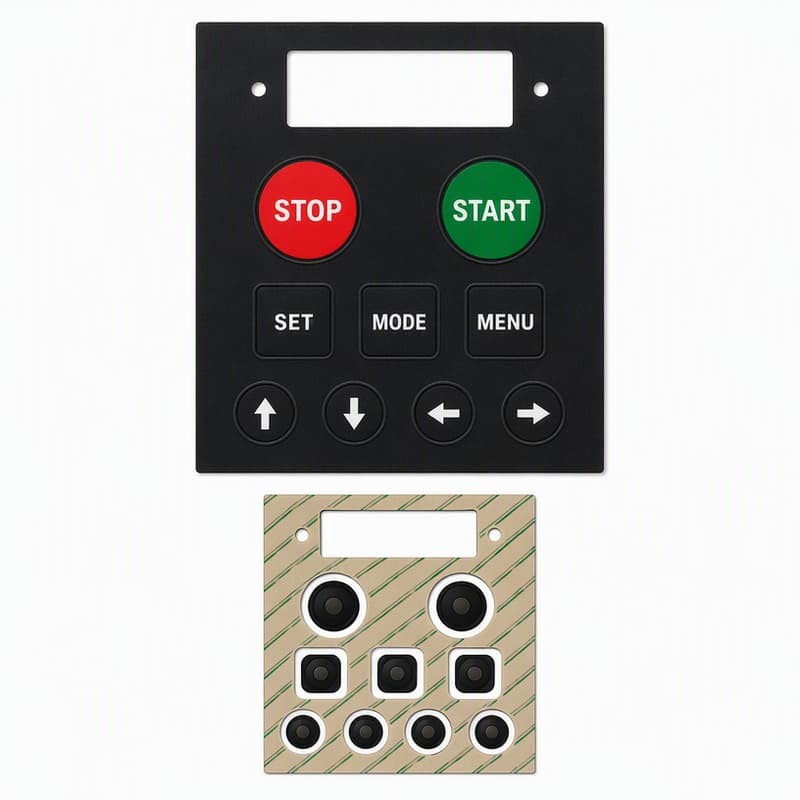
There is a fourth actor, and it is not rubber at all. Silicone expands and contracts about two to three times more than the engineering plastics around it — roughly 190–255 × 10⁻⁶/K for silicone versus 60–90 × 10⁻⁶/K for typical ABS and PC housings [4]. Over a 45 °C seasonal swing, the differential adds up. The pad can bind at the edges, legends drift relative to the housing windows, and the preload on a gasketed keypad changes enough to move the operating point of the buttons.
Outdoor units add a fifth: condensation. A cold panel brought into a warm room collects water, and if that water freezes in the web gap, travel is mechanically blocked until it thaws. None of these are material defects. All of them show up as "buttons feel different in winter."
What we changed for an outdoor dosing controller
A customer builds dosing controllers that sit on chemical feed skids, half of them outdoors in climates that reach −20 °C. Winter complaints were consistent: stiff keys, slow returns, one button that stopped clicking entirely. Their first instinct was to change hardness, which would have made the panel worse at room temperature.
We ran force-travel curves on production parts conditioned at −20 °C, 25 °C and 60 °C (conditioning per ISO 23529 [5]). The data showed peak force up roughly 35% at −20 °C while return force barely moved — the snap ratio dropped from about 50% to about 25% on the worst key. The fix was three parts:
- A compound with better low-temperature recovery, validated with a low-temperature compression set test (ISO 815-2 method) instead of a datasheet claim.
- A slightly thinner web skirt and re-profiled dome so the snap ratio at −20 °C landed back inside the 40–60% band, while the 25 °C force stayed within the original spec.
- A housing clearance review with their mechanical team, because the CTE mismatch was loading the pad edge in the cold.
The part family now carries a written requirement: actuation force verified at −20 °C, not only at room temperature. Two winters later, the ticket queue for that product is empty. The same pattern shows up in other cold-exposed products — outdoor pH meters fail the same way, and the fix follows the same logic (we wrote up the pH meter case here).
A short checklist before you cut the mold or place the PO
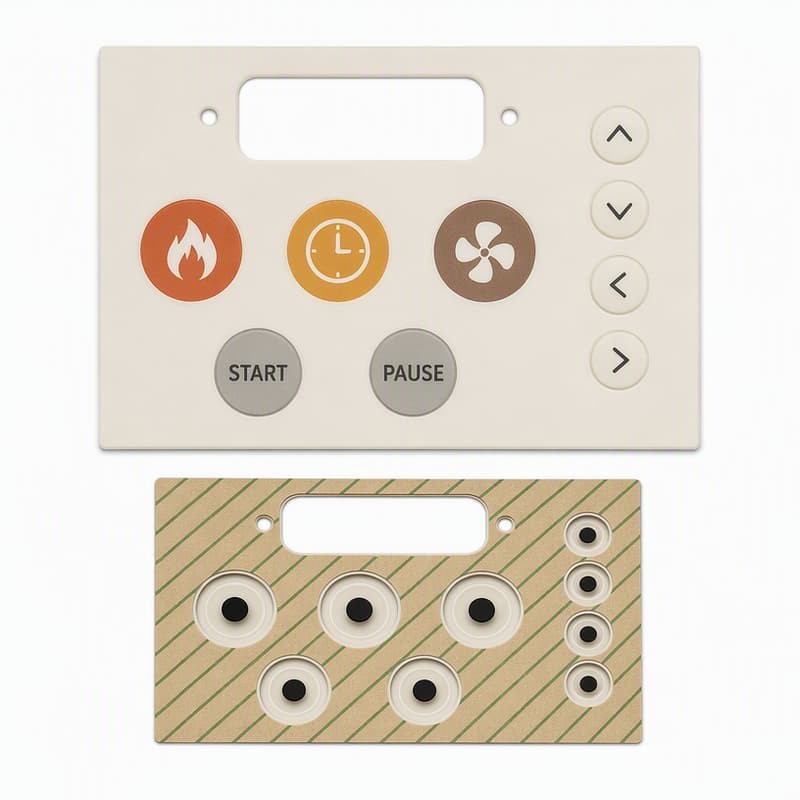
- Write the actuation force and snap ratio for the operating temperature range, not for 25 °C. "150 g at 25 °C" is a lab spec; "150 g at −20 °C" is a field spec.
- Condition test parts at the cold temperature before measuring (ISO 23529), and measure force-travel on the finished part, not on a test slab.
- If the unit sits outdoors, ask for low-temperature recovery data (ISO 815-2 style), not just the standard compression set number.
- Check the fit budget: silicone's thermal expansion is two to three times that of the housing plastic. Leave clearance, and do not over-constrain the pad.
- If legends are coated, ask whether the coating was flex-tested at the cold end. Coatings crack at −20 °C even when the silicone is fine.
FromRubber makes custom silicone keypads for industrial and appliance customers. We compound the material, cut the tooling, mold the parts, and bench-test every feel specification on finished parts — durometer on the batch slab, force-travel-snap at the temperatures the equipment actually runs at. If a panel feels wrong in the cold and you cannot tell whether it is material, geometry, or housing, send the drawing and the operating temperature range and we will return a test plan that separates the three.
Sources and test references used in this article:
- Revisiting the Thermal Transitions of Polydimethylsiloxane Elastomers: Addressing Common Misconceptions with Comprehensive Data, Macromolecular Materials and Engineering, 2025, DOI 10.1002/mame.202500075. Glass transition of silicone elastomers ≈ −120 °C; storage modulus falls from 1–10 MPa at −100 °C to roughly 0.1–2 MPa at 25 °C.
- ISO 815-2:2019, Rubber, vulcanized or thermoplastic — Determination of compression set — Part 2: At low temperatures.
- Diamond HMI, Rubber Keypad Design Guide: actuation force 125–150 g with snap ratio 40–60% recommended for tactile keypads; Plastec silicone keypad design reference reports the same band.
- NETZSCH Analyzing & Testing, silicone rubber property data: glass transition −135 to −120 °C, coefficient of linear thermal expansion 190–255 × 10⁻⁶/K; typical ABS/PC housing CTE 60–90 × 10⁻⁶/K per standard plastics datasheets.
- ISO 23529:2016, Rubber — General procedures for preparing and conditioning test pieces for physical test methods.