Creep Under Load in Plastic Seal Parts
A seal is a compressed part. Thermoplastics relax over time, and how much they relax decides whether the seal still works at the end of the product life.


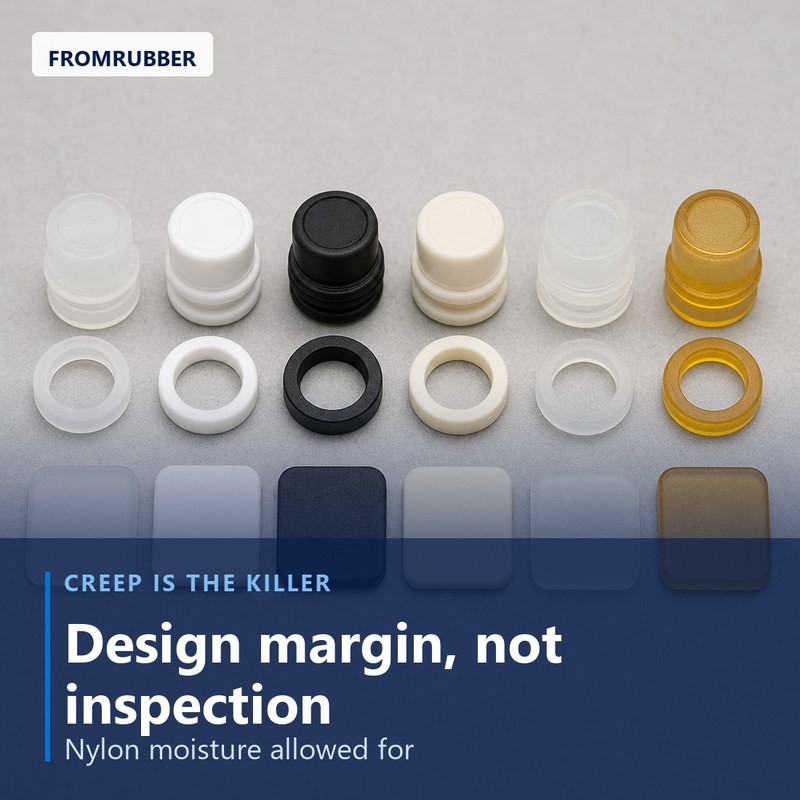
A plastic seal part fails for one of three reasons: the material creeps under load, it swells in the medium, or the tolerance cannot be held at the wall thickness. Choosing among ABS, PP, PE, nylon, TPE and TPU is therefore a decision about service conditions, not about price per kilo. A seal is a compressed part. Thermoplastics relax over time, and how much they relax decides whether the seal still works at the end of the product life. PP and PE resist most aqueous and many solvent media; ABS does not. The medium decides the shortlist before anything else. TPE and TPU give an elastomer-like seal in a thermoplastic process, which suits overmolded and assembled parts. Material selection is usually argued in the wrong order. The first question is what the part touches: water, detergent, oil, alcohol or fuel. Each of those narrows the list hard. Only then does temperature matter, and only then does the load case decide between a rigid and a soft grade. ABS is a good example of a material that gets misapplied. It is tough, dimensionally stable and easy to mold, so it appears in seal drawings; but it has limited resistance to many solvents and it relaxes under sustained compression. It belongs in housings and covers, not in a seal that has to hold pressure for years. PP and PE are the default for water, detergent and most cleaning chemistry, and they are the cheapest route where a rigid seal body is acceptable. Nylon offers better resistance and much higher wear resistance, at the cost of moisture absorption that changes dimensions. TPE and TPU provide a compliant sealing lip in a thermoplastic process, including overmolding onto a rigid substrate. Relative guidance for seal and gasket parts. Ratings are comparative and must be confirmed against the actual medium and temperature. Moisture absorption in nylon and creep in polyolefins are the two effects that most often cause a field failure. Both are addressed by design margin, not by tighter incoming inspection. The medium eliminates most candidates before price is discussed. A multi-material program usually runs on several tools, which is why lot size matters. Small lots justify a simple single-cavity tool and a family layout; large lots justify hardened steel and higher cavitation. Quoting one tool for both cases is how a project ends up either over-invested or under-capacity. Where a seal combines a rigid body with a soft lip, overmolding removes an assembly step and a bonded joint. Our <a href="https://www.fromrubber.com/comm23/Over-Molding.htm">overmolding</a> capability covers thermoplastic and silicone combinations, and it is the usual route when the two materials have to stay together under load. Several similar seal sizes can share a family tool, which keeps the entry cost sane for low-volume ranges. Higher cavitation lowers unit cost but raises tool cost and lead time, so it is decided on annual volume. A soft lip molded onto a rigid body avoids adhesive and an assembly step, provided the materials are chemically compatible. The matrix narrows the field; the prototype proves the choice. The medium, service temperature and compression load eliminate most materials immediately. A prototype in the shortlisted material is compressed or immersed to check creep and swelling in practice. Wall thickness, draft and gate position follow the material, since each grade fills and shrinks differently. First-article inspection confirms the tolerance at the sealing face after the part has settled. PP or PE for a rigid body, TPE or TPU where a soft sealing face is needed. The choice depends on whether the part has to compress or only has to block. Yes. Family tooling and single-cavity tools make low-volume ranges practical, and the tooling plan is quoted against the annual volume rather than the first order. Nylon absorbs moisture and grows slightly. For a sealing face that movement has to be allowed for in the tolerance, or the part will bind after conditioning. Send the medium, service temperature, compression load and annual volume. We will shortlist the material and quote tooling against the real lot size. Related capabilities: Plastic seals range · Plastic injection parts · Overmolding
Plastic Seal Parts in ABS, PP, PE, Nylon, TPE and TPU: A Material Matrix
Creep Under Load in Plastic Seal Parts
Chemical Compatibility of Seal Plastics
Soft TPE and TPU Grades for Sealing
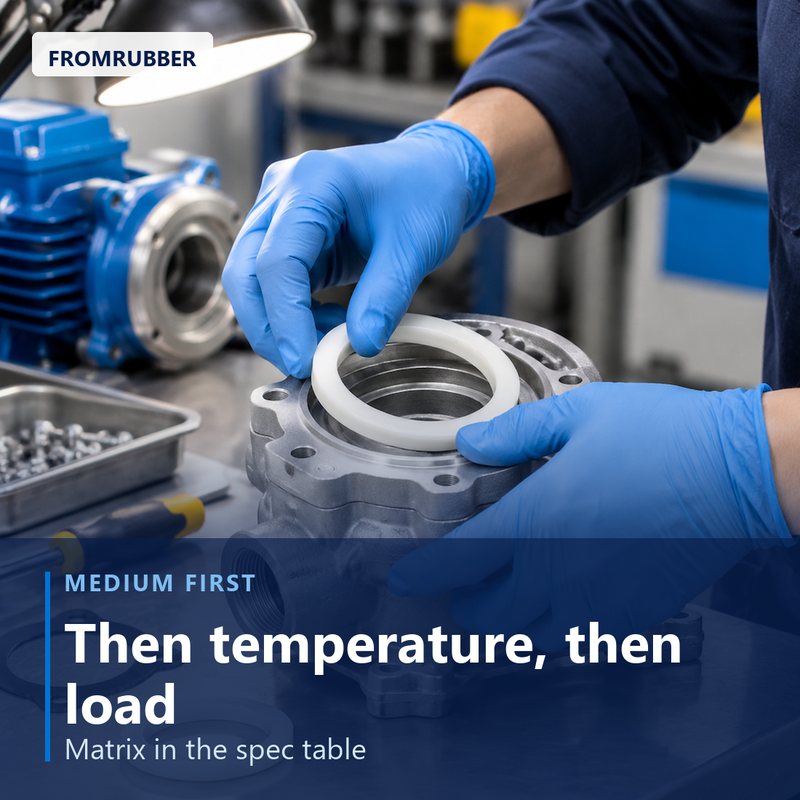
Read the Medium First, Then the Temperature, Then the Load
Aqueous and Detergent Media
Oils, Fuels and Solvents
Soft Sealing Faces

Plastic Seal Material Comparison
ABS Moderate temperature, poor solvent resistance, rigid and dimensionally stable: housings and covers, not pressure seals PP Good aqueous and detergent resistance, moderate temperature, semi-rigid: water and detergent seal bodies PE Good chemical resistance, low stiffness, excellent moisture barrier: low-load seals and liners Nylon Good wear and oil resistance, absorbs moisture and changes dimension: wear rings and moving seal parts TPE Soft, good grip and sealing, moderate temperature: overmolded sealing lips and soft-touch seals TPU High abrasion resistance, good oil resistance, strong elastic recovery: dynamic seals and wear parts
Material chosen by medium
Tooling and Lot Size for Multi-Material Seal Programs
Family Tools for Small Lots
Cavitation for Volume
Overmolding for Two-Material Seals
How a Plastic Seal Part Is Specified
Define Media and Load
Confirm With a Prototype
Design the Tool
Validate Dimensions
Plastic Seal Questions Engineers Ask
Which plastic is best for a water seal?
Can you mold small production lots?
Why does a nylon seal change fit over time?
Choosing a Material for a Seal or Gasket Part?

