Can a Silicone Keypad Handle 100°C on Automotive Test Rigs?
- Share
- publisher
- Suey
- Issue Time
- Aug 27,2026
Summary
Can a silicone keypad handle 100°C on automotive test rigs? Yes, if specified for it: heat-stabilized compound, gold-plated pads, laser-etched legends and thermal-cycle acceptance criteria.
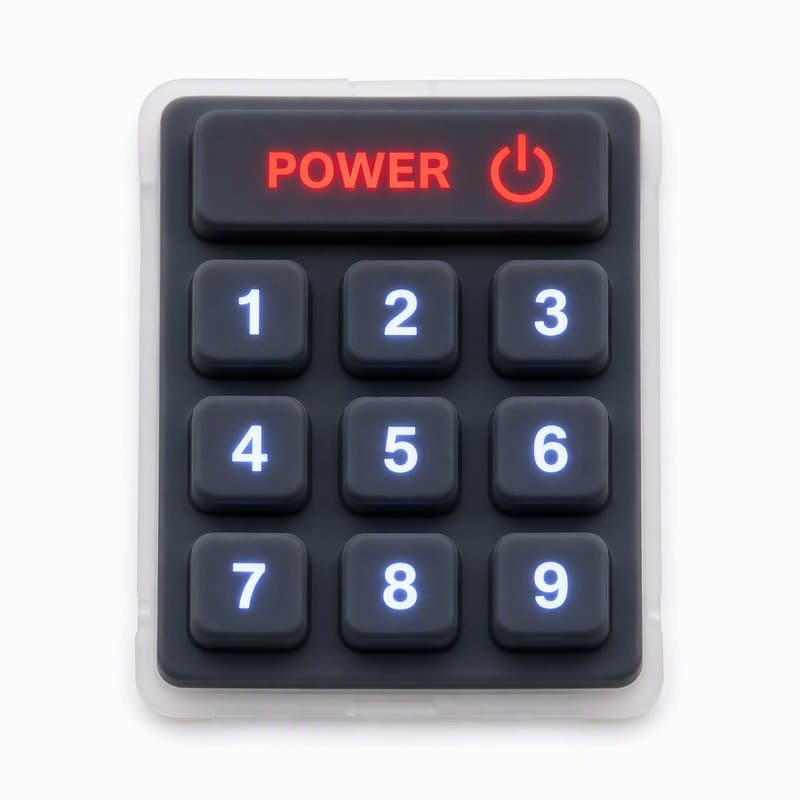
High-Temperature Silicone Keypad Engineering
Automotive test rigs run hot by design: engine dynamometers bake their control panels, chamber controls sit beside exhaust ducts, and durability test cells hold 90–105°C ambient for days at a time. The question "can a silicone keypad handle 100°C?" sounds simple, but the honest answer is "it depends on what you mean by handle." Standard keypad compounds survive 100°C for short bursts; staying functional for the life of the rig is a different specification. This article separates the material science, the failure modes, and the test methods, so you can specify a silicone keypad that genuinely works at 100°C on automotive test rigs.
1. The 100°C Question on Automotive Test Rig Keypads
Heat in an automotive test cell does not arrive as a steady, uniform 100°C. It arrives as cycles: cold start to full load, exhaust-side hot spots that exceed the ambient reading, control panel surfaces warmed by radiated heat and by the operator's own body heat in a sealed room. A keypad that must "handle 100°C" is really being asked to survive thousands of thermal cycles with a peak well above 100°C, while maintaining tactile feel, contact reliability, and legend legibility. The difference between a lab-bench "yes" and a field "yes" is the difference between a material data sheet and a qualification test.
General-purpose silicone keypad compounds are rated for continuous service around 150–200°C before polymer degradation becomes the limiting factor - so the material itself is rarely the first thing to fail at 100°C. The first things to fail are the contact system, the legends, the color pigments, and the mechanical feel. Each has its own temperature limit, and each must be specified separately. Our article on high-temperature-resistant silicone keypads covers the compound selection side of this in more depth.
2. Silicone's High-Temperature Limits: What the Data Says
Silicone rubber is the best general-purpose elastomer for sustained heat, but "silicone" covers a wide formulation range. Three material properties matter for a 100°C keypad:
- Heat aging (compression set). ASTM D395 compression set after 70 h at 150°C is typically 10–20% for a good VMQ compound. At 100°C sustained, set accumulates more slowly but still degrades the keypad's ability to spring back, which is why the keypad loses its tactile snap over years - the same mechanism documented in our compression set study.
- Post-cure and additives. A properly post-cured compound resists 100°C without outgassing or surface bloom; under-cured parts soften and migrate plasticizer-like fractions, which can contaminate contact pads.
- Color and legend stability. Organic pigments fade at elevated temperature. For a 100°C-rated keypad, use inorganic pigments or laser-etched legends rather than bright organic screen inks, which are the first visible casualty of sustained heat.
The real-world temperature limits of keypad materials are discussed in our field guide What Temperature Does Your Silicone Keypad Actually Tolerate in the Field?, which includes the measured force and set curves for typical instrument compounds.
3. Where 100°C Breaks a Silicone Keypad: Aging, Compression Set and Contacts
At 100°C, three components degrade on different timescales. The silicone body degrades slowest - decades at 100°C for a good compound. The legends degrade faster: organic screen inks fade within months in a hot, UV-lit test cell. The contact system degrades fastest of all: carbon pills are thermally stable, but the PCB pads they touch oxidize more quickly at temperature, and conductive ink keypads can drift as the ink's silver loading migrates under bias. The net effect is a keypad that still looks fine but reads high contact resistance - intermittent keys on a rig that is supposed to run unattended.
The classic failure signature is a key that works cold and misses warm. On a test rig that heats up during a run, operators learn to press keys twice, and the data logger fills with double triggers. If your rig shows this pattern, measure contact resistance at temperature before touching the firmware: a 4-wire measurement at 100°C on the suspect key will separate a contact problem (resistance climbing from tens to thousands of ohms) from a software problem. The same diagnostic logic is detailed in our PCB assembly and contact failure guide.
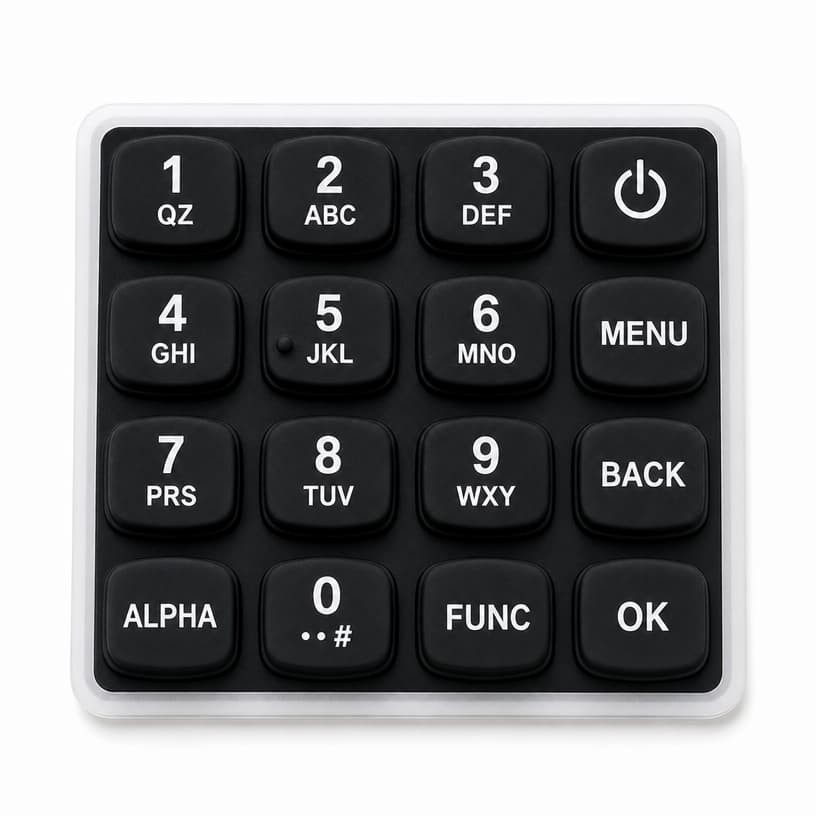
Gold-plated pads (ENIG) are the standard fix for hot, humid contact environments: they keep contact resistance stable at temperature and through condensation cycles. If the PCB is already bare copper, a 100°C-rated keypad specification should flag the pad finish as a dependency, not an assumption.
4. Designing a 100°C-Rated Silicone Keypad for Test Rigs
Specifying a keypad for 100°C automotive test rigs means writing six lines into the drawing:
Compound: heat-stabilized VMQ with post-cure, compression set ≤ 15% after 70 h at 150°C (ASTM D395 Method B)
Actuation force specified at operating temperature (100°C), typically 200–260 gF with snap ratio > 1.4
Contact system: carbon pill with ENIG/gold-plated PCB pads; contact resistance ≤ 200 Ω at 100°C
Legends: laser-etched or inorganic-pigment screen printing; 3M tape + rub acceptance at elevated temperature
Heat-soak test: 1,000 h at 105°C, then full functional retest
Thermal cycling: 1,000 cycles 25↔100°C with actuation and contact checks at both ends
Material quality is the hidden variable: recycled or heavily filled silicone compounds fail heat aging far faster than virgin heat-stabilized grades. Our guide on verifying premium vs. recycled silicone shows the practical checks - durometer drift, density, and heat-aging samples - that separate the two in a supplier audit.
5. Case Study: Dynamometer Control Keypads After 3,000 Hours at 105°C
An engine test facility reported that dyno control keypads - 16-key silicone keypads with carbon pill contacts on bare copper pads - became intermittent after roughly nine months of operation, always during long high-load runs. The rigs were well-ventilated, but the control panel ambient was measured at 95–105°C near the exhaust duct. Initial troubleshooting blamed the control software; the logs showed double triggers, which the team first filtered in firmware.
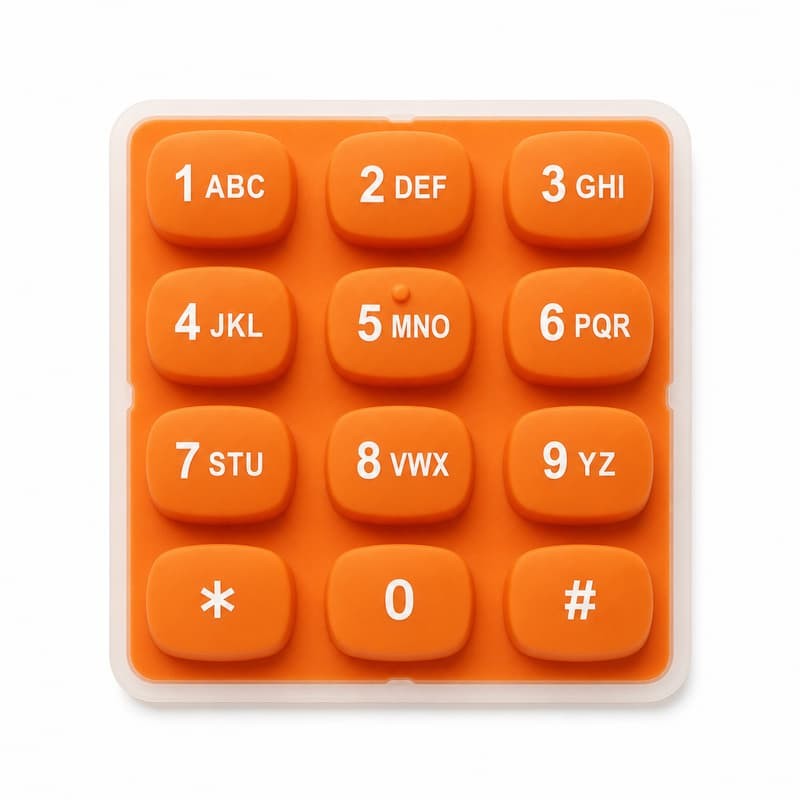
We reproduced the fault in a heat-soak chamber: at 100°C, contact resistance on the bare copper pads drifted from a healthy 40–60 Ω to over 1 kΩ within 200 hours, and the screen-printed legends on the START and STOP keys began fading at the same time. The replacement keypads used ENIG pads, a heat-stabilized post-cured compound, laser-etched legends, and a dome designed to hold 230 gF at 100°C. After 3,000 hours at 105°C, the re-qualified keypads showed contact resistance under 150 Ω on all keys and no measurable legend wear.
The facility standardized the new keypad across all nine dynamometer cells. The cost difference was a few dollars per keypad; the avoided cost was repeated downtime on rigs billing thousands of dollars per hour. The full qualification sequence - compound data, heat-soak, thermal cycling, contact measurement at temperature - is the same discipline described in our guide to instrument-grade keypad failures.
6. Test Methods and Acceptance Criteria for High-Temperature Silicone Keypads
Put the acceptance criteria in the drawing so the supplier can quote against them:
| Test | Condition | Acceptance |
|---|---|---|
| Heat aging | 1,000 h at 105°C (compound level) | Shore A change ≤ 5; no cracking |
| Compression set | ASTM D395 B, 70 h at 150°C | ≤ 15% |
| Contact resistance at temp | 4-wire, 100°C soak | ≤ 200 Ω per key |
| Thermal cycling | 1,000 cycles 25↔100°C | Full function at both ends |
| Legend durability | 3M tape + 10k rub at 100°C | No legend loss or fade |
Material behavior at these temperatures is documented by silicone suppliers such as Dow and Wacker, with test methodology per ASTM D395 / D573. Engineering estimates in this article reflect FromRubber project records for automotive test equipment keypad programs.
7. High-Temperature Keypad FAQ
Will a standard silicone keypad melt at 100°C?
No - standard VMQ compounds do not melt or soften at 100°C; continuous-service ratings are typically 150–200°C. The failures at 100°C are contact drift, legend fade, and tactile set, not melting.
Is 100°C ambient the same as 100°C on the keypad surface?
No. Enclosed panels and direct radiant heat can put the keypad surface 10–30°C above ambient. Measure the surface temperature on the real rig and spec against that number.
Can I just add a fan to cool the keypad?
Sometimes, but cooling the panel does not fix contact oxidation already underway, and fans add failure points on a rig built for unattended runs. Specifying the keypad for the real temperature is the durable fix.
Sources and Further Reading
The technical figures in this article draw on published industry material: Dow - Silicone Elastomer Heat-Aging Data, Wacker - Liquid Silicone Rubber Properties, and ASTM D395 / D573 test standards. Engineering estimates specific to this article reflect FromRubber project records for automotive test equipment keypad programs. Related reading: high-temperature-resistant keypads, compression set and rebound, and the Silicone Keypad Technology Sharing series.
About FromRubber - FromRubber is a full-process silicone keypad manufacturer for automotive, industrial and instrument applications, covering heat-stabilized compound selection, mold making, molding, printing, backlighting and environmental testing under one roof. If your test rig keypads are failing at temperature, our lab can run the heat-soak and thermal-cycle qualification described in this article and quote a 100°C-rated keypad against your drawing.