Stair Climber Silicone Keypad Button Travel and Tactile Response Explained
- Share
- publisher
- FromRubber
- Issue Time
- Sep 14,2026
Summary
Travel on a stair climber keypad is a budget, not a fixed dimension: assembly preload, ambient temperature and uneven press counts all spend it. This article separates working travel from overtravel, explains the return force floor that drawings usually omit, and shows how a six-key programme panel went flat on only two keys.
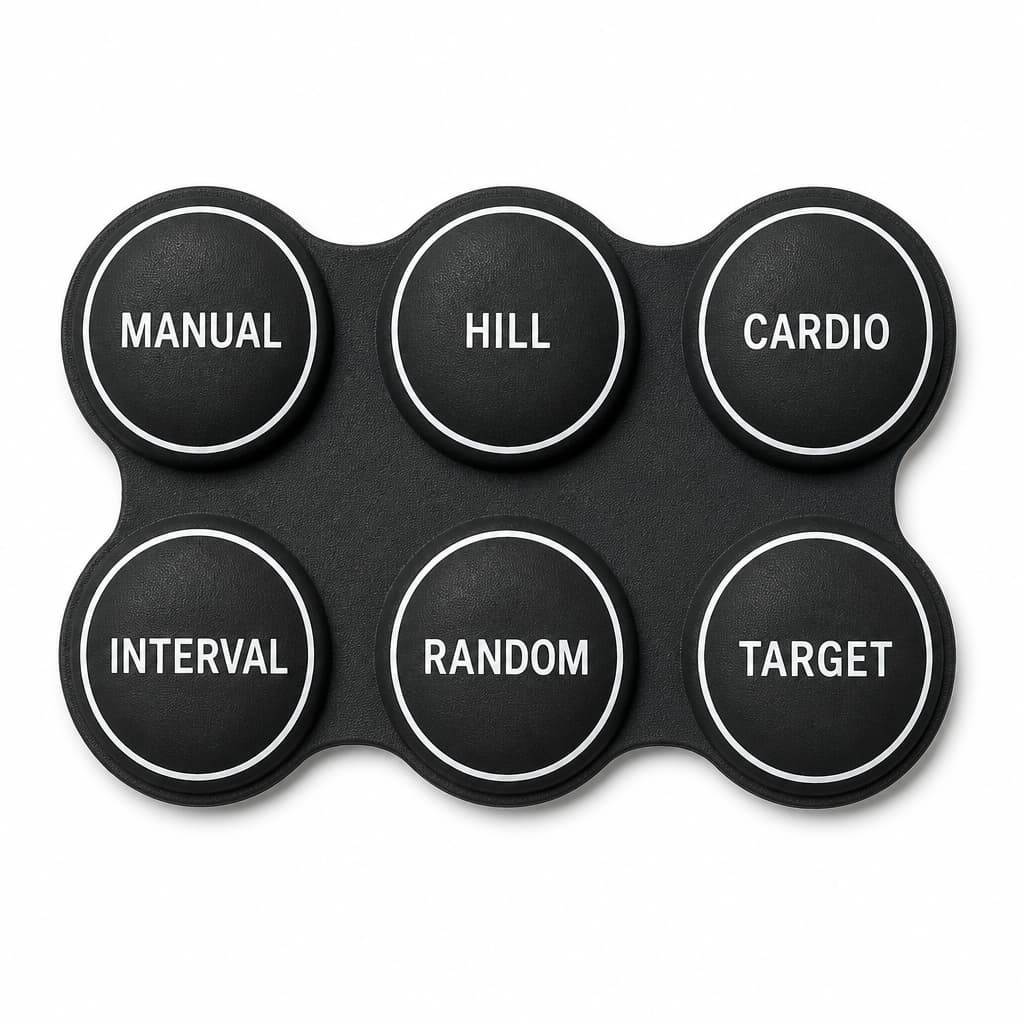
A stair climber silicone keypad is usually specified with one travel figure in millimetres and one force figure in grams. Three years later the same machine feels vague, and the panel gets blamed. The trouble is that travel is not a number that holds still. It is a budget, and it gets spent by assembly preload, by ambient temperature and by the two or three keys that take ten thousand times more presses than the rest of the panel put together. Reading travel as a single dimension is what makes tactile response unpredictable on a machine that is otherwise correctly designed.
Travel is three measurements pretending to be one
When a drawing says travel, the value is usually one of three different measurements, and the three do not move together. The first is total travel, the full stroke from rest to bottom-out. The second is working travel, the distance between the point where the force cone snaps through and the point where the contact closes. The third is overtravel, whatever remains after the circuit has already made. The operator only feels the second one. The circuit only cares about the third.
Published keypad design data puts typical keytop travel for a conductive silicone design at roughly 0.03 to 0.07 inches, with actuation force usually quoted between about 60 and 200 grams and a snap ratio of about 40 to 60 percent for a click that reads clearly. Those are useful starting windows, but they are measured on a single free key pressed straight down at a nominal temperature. None of those conditions survive the trip onto a stair climber.
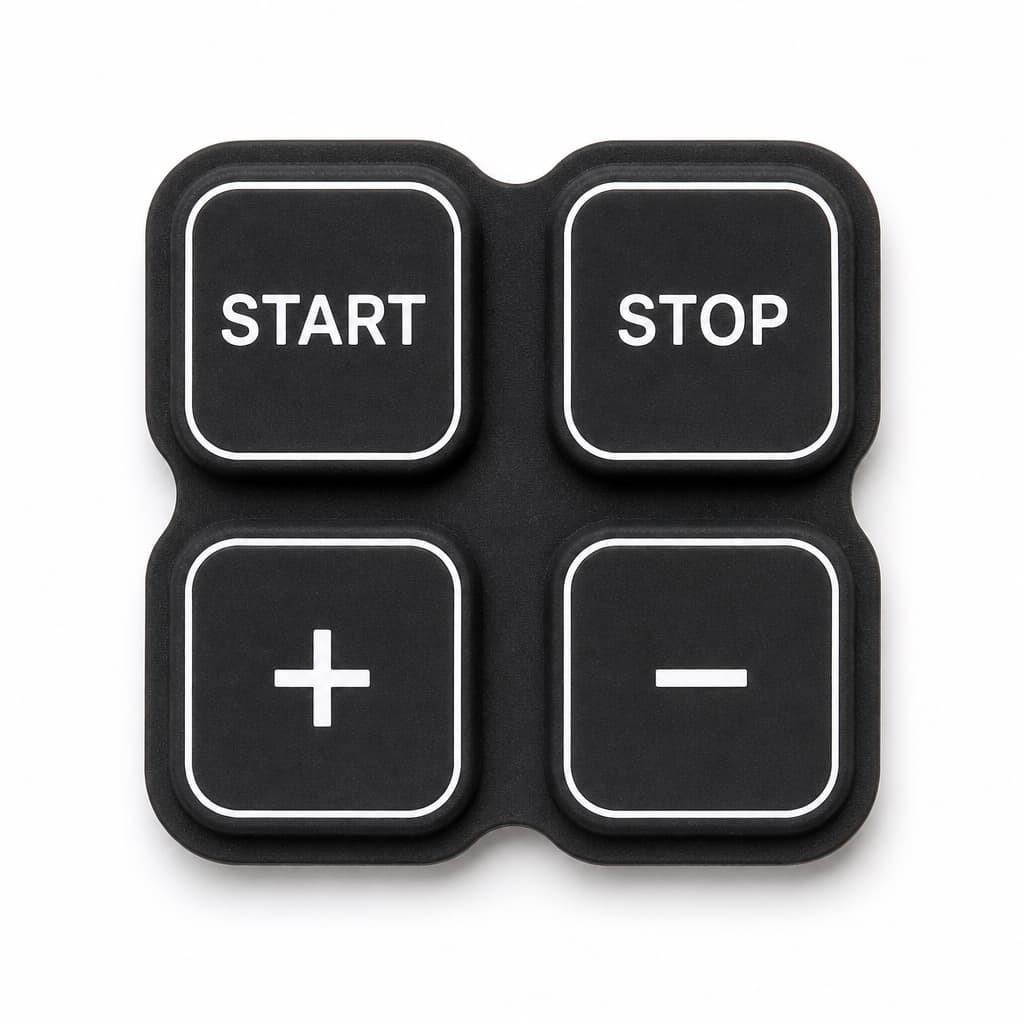
The four keys on this panel do not have equal jobs
On a start-stop-adjust cluster, START is pressed once per session, STOP is pressed once or twice per session, and the two adjust keys are pressed dozens of times in the first minute alone. If all four keys are given the same cone geometry because they sit in the same moulding, two of them are over-built and two are under-built.
The practical fix is to allocate travel and force per key, not per panel. The high-frequency keys get a slightly deeper cone and a firmer return; the session keys get a shorter stroke that is easier to read as a single event. On the panel above, the two adjust keys are the ones whose force-travel curve actually decides whether the machine feels responsive.
The return force floor is the number that is usually missing
Force-travel curves are normally specified with an actuation force and a snap ratio, and both of those describe the press. Almost nothing is written about the return. This is backwards for a stair climber, because on a stair climber a key is often pressed while a thumb is already resting on the panel, and the cone has to lift the keytop against loads that were never in the test setup.
Two loads matter. The first is assembly preload: how hard the housing presses the flange down onto the key cone. The second is the resting load of the operator's hand, which on a compact console is not zero, because the console is at chest height and people lean. If the return force of the cone is below those two combined, the key does not come back to its rest position between presses. The panel then behaves as though it has a shorter travel than the drawing, because each press starts from a partly depressed state.
Measure the return, not just the press. A working spec for a compact console: press the assembled panel with the housing torqued to production value, then hold the keytop down and release it slowly while logging the force at which the cone lifts the keytop back to rest. That release force should stay above the housing preload plus the expected resting hand load, with margin. A panel that meets its actuation force target and has no return-force floor is only half specified.
Cold air changes the number more than most briefs allow for
Silicone stiffens as it cools. The change is not dramatic in the middle of a gym, but stair climbers are not only in the middle of gyms. They sit in hotel fitness rooms near doorways, in apartment building gyms on external walls, in unheated garages and in training rooms that are cooled overnight. On a cold morning the first few presses on a cold panel will feel firmer and shorter than the same presses twenty minutes later.
That is a real effect on the same part, not a defect, and it is exactly what our own field notes on industrial panels describe: a button that feels right in a temperature-controlled room can feel different on a cold panel. For a stair climber silicone keypad the visible consequence is usually a stop key that feels heavier at the start of a shift. It matters because the stop key is the one key where a heavier stroke is interpreted by the operator as a fault rather than as a characteristic.
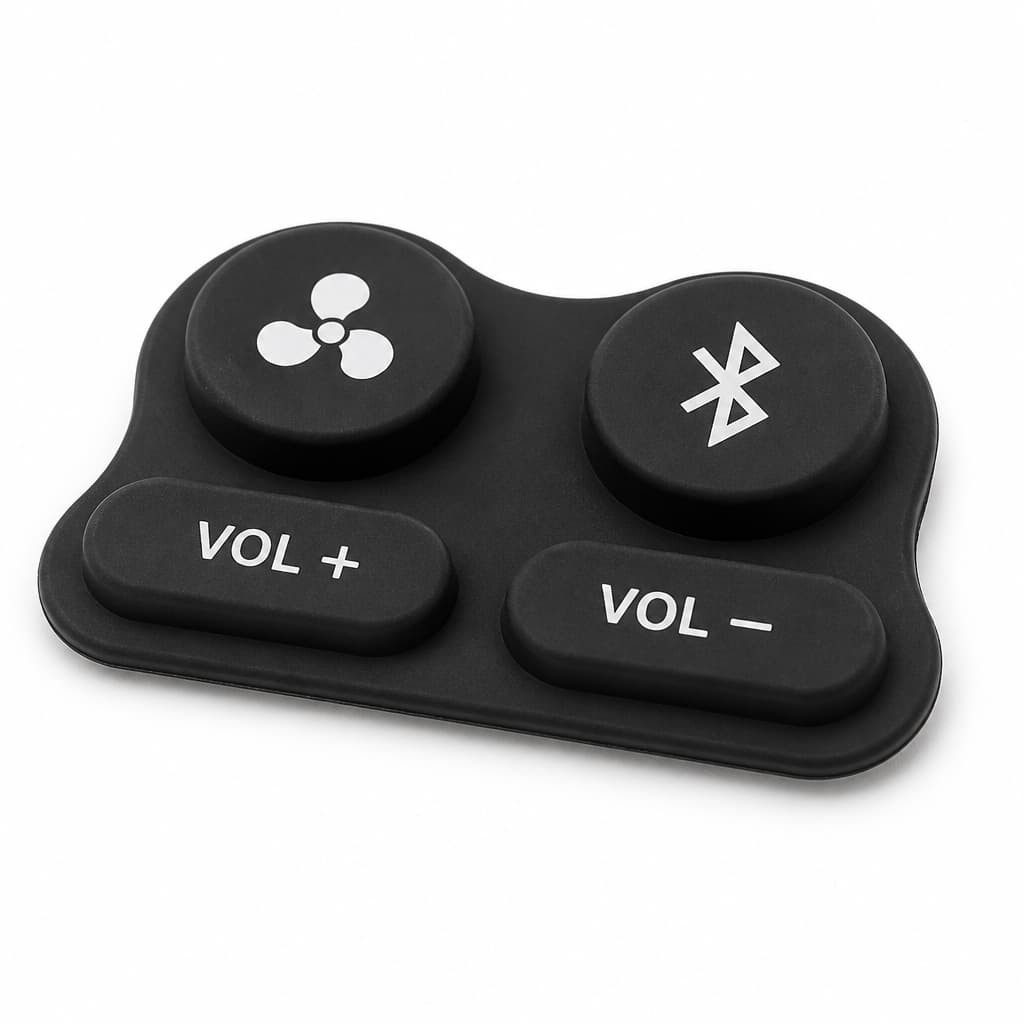
One moulding, several force zones
Media and utility keys on a console are pressed at rest, usually while the operator is looking at the panel. There is no vibration to overcome and no penalty for a slower press, so there is nothing to gain from a firm, deep cone. Building them lighter makes the panel easier to use and reduces the force the operator has to apply to keys that are off to the side of the console face.
Mixing zones inside one moulding is normal practice, but it has to be stated on the drawing. When a customer sends one target force for a whole panel, the natural result is that every key is built to the same cone and the low-frequency keys end up stiffer than the application wants. The better brief lists a force band per key group and a travel band per key group.
What actually shortens travel over a machine's life
Travel does not fade because silicone gets tired. It fades because the geometry that produces the travel changes, and the change is measurable. Compression set is the property that governs it: it describes how much a rubber section fails to return to its original thickness after being squeezed, and it is measured by ASTM D395 and, in the ISO family, by ISO 815-1. A cone that is permanently compressed by a few hundredths of a millimetre has lost that much travel, and it has lost it exactly in the part of the stroke the operator feels.
- Assembly preload over time. A flange that is compressed into a housing groove takes a set, so the preload at year three is not the preload at month one.
- Cycle asymmetry. The keys with the highest press counts lose height first, which is why a panel rarely goes soft evenly.
- Contact surface contamination. Dust and skin oil on the conductive path raise the resistance the input circuit has to read, which is perceived as a longer press even though the stroke has not changed.
- Hardness drift in service. Hardness measured by ASTM D2240 or the ISO 48 equivalent on a production sample is the number that belongs on the drawing, and it should be tested on the moulding plane the key actually uses.
Uneven press counts are the reason a panel goes soft unevenly
On a panel like this, the programme keys are pressed once per session, the two or three favourite programmes are pressed every session, and the level keys next to them are pressed continuously during the first minute. Over a machine life measured in millions of presses, the gap between the busiest key and the quietest key is not a small percentage. It is orders of magnitude, and each press spends a little of the cone height that produces the travel.
That is an argument for specifying the panel as two or three key groups rather than as one part. It is also an argument for inspecting the busiest keys, not the average key, when a warranty panel comes back for review.
Notice what this list implies. The failure is not a material burnout in the middle of the panel. It is a geometric drift in the two or three keys that are used most, and it appears as a change in feel rather than as a change in function. That is why a panel can be well inside its specified wear life and still generate complaints.
Case: a programme panel that felt wrong only on two keys
Symptom. A six-key programme panel on a stair climber drew complaints that the two most-used programme keys felt flat, while the other four keys on the same moulding were described as fine. Bench curves on new parts were uniform across all six keys.
Measurement. Curves were re-run on the assembled panel at three temperatures and after an accelerated press sequence on the two suspect keys only. At room temperature the panel matched the drawing. On a cold panel the actuation force on the two keys rose well above the target band while the release force stayed close to the housing preload, so the keys returned slowly and the following press began from a partly depressed keytop.
Root cause. The panel had been specified with one force target and one travel target for all six keys, and the cone geometry had been adjusted during tooling to hit that single target. No return-force floor had been defined, and the assembly preload had never been measured on the torqued housing. In service, the two high-frequency keys spent their cone height first, and the low-temperature stiffening made the effect visible at the start of every shift.
Fix. The programme keys were split into two groups on the drawing, with a deeper cone and a higher return-force floor for the high-frequency pair, and a defined compression groove in the flange so that preload stopped being an uncontrolled input. The panel for the other four keys was left unchanged.
What it suggests. A single travel number does not describe a panel. It describes one key under one set of conditions, and both of those are decisions the drawing should make explicitly.
FAQ
Is longer travel always better for a stair climber silicone keypad?
No. Longer travel gives a clearer press and is more tolerant of gloves or of a hand pressing at an angle, but it also means a longer stroke that has to be recovered before the next press, and it puts more demand on the return force of the cone. On a compact console where the operator taps repeatedly, a moderate stroke with a well-defined return is usually easier to live with than a long one.
Should travel be specified as a range or a single value?
Always a range, and preferably two ranges: one for working travel and one for the release force at the end of the stroke. A single number gives the moulder no information about whether the key must return quickly or can return slowly, and those two requirements pull the cone geometry in different directions.
Does travel have to be re-checked if the silicone hardness changes?
Yes, because hardness and cone geometry are the two inputs that produce the force-travel curve. Changing hardness to move the feel is a change to the curve, which means the travel band and the release force have to be re-verified on the assembled panel rather than assumed to follow.
Conclusion
Travel and tactile response on a stair climber silicone keypad are decided by the part of the curve that nobody writes down: where the cone releases, how much force it takes to push the keytop back into position, and which keys carry the press count. Specify the curve per key group, put a floor under the return force, and verify it on the torqued assembly rather than on a loose moulding, and the panel will still feel like the same panel in the third year. FromRubber moulds custom silicone keypads and button panels for fitness and industrial equipment, and reviews force-travel data against the customer's housing and board before tooling is cut.
This article was written by the moulding engineering team at FromRubber, a custom silicone keypad and button manufacturer in Dongguan, China. We mould control panels for fitness, medical and industrial equipment. The checks described here are the ones we run on our own shop floor before a panel is released to production.
Related reading
Sources
- [1] Epec Engineered Technologies, Conductive and non-conductive rubber keypad comparison — typical keytop travel 0.03 to 0.07 inches for conductive rubber keypads, control force and tactile snap differences. https://www.epectec.com/articles/conductive-and-non-conductive-rubber-keypad-comparison.html
- [2] Epec Engineered Technologies, Rubber Keypad Design Guide — travel, force and life cycle ranges. https://www.epectec.com/keypads/design/
- [3] J.W. Electronic Components, Design guide for rubber keypads — snap ratio guidance of 40 to 60 percent for tactile feel and life. https://www.jw-electronic-components.de/pdf/Design%20guide%20for%20rubber%20keypads.pdf
- [4] ASTM International, Standard Test Methods for Rubber Property — Compression Set, ASTM D395-18. https://store.astm.org/d0395-18.html
- [5] ISO, Rubber, vulcanized or thermoplastic — Determination of compression set — Part 1: At ambient or elevated temperatures, ISO 815-1, ISO standard record. https://www.iso.org/standard/61761.html
- [6] ASTM International, Standard Test Method for Rubber Property — Durometer Hardness, ASTM D2240-15(2021). https://www.astm.org/d2240-15r21.html
- [7] ZwickRoell, Shore hardness and durometer hardness testing to ASTM D2240 — test force range and measurement principle. https://www.zwickroell.com/industries/plastics/thermoplastics-and-thermosetting-molding-materials/hardness-testing/shore-hardness-test/
- [8] ISO 20957-8:2017, Stationary training equipment — Part 8: Steppers, stairclimbers and climbers. https://cdn.standards.iteh.ai/samples/70975/0fab6016375c465282ea8d5b8d3ea2fc/ISO-20957-8-2017.pdf
- [9] FromRubber, Why your industrial panel buttons feel different in winter. https://www.fromrubber.com/blog/Why-Your-Industrial-Panel-Buttons-Feel-Different-in-Winter_b33672