Silicone Beauty Mask Fit Without Pressure Points
The shell is molded to a face form rather than cut from sheet, so eye, nose and jaw openings can be positioned instead of approximated.


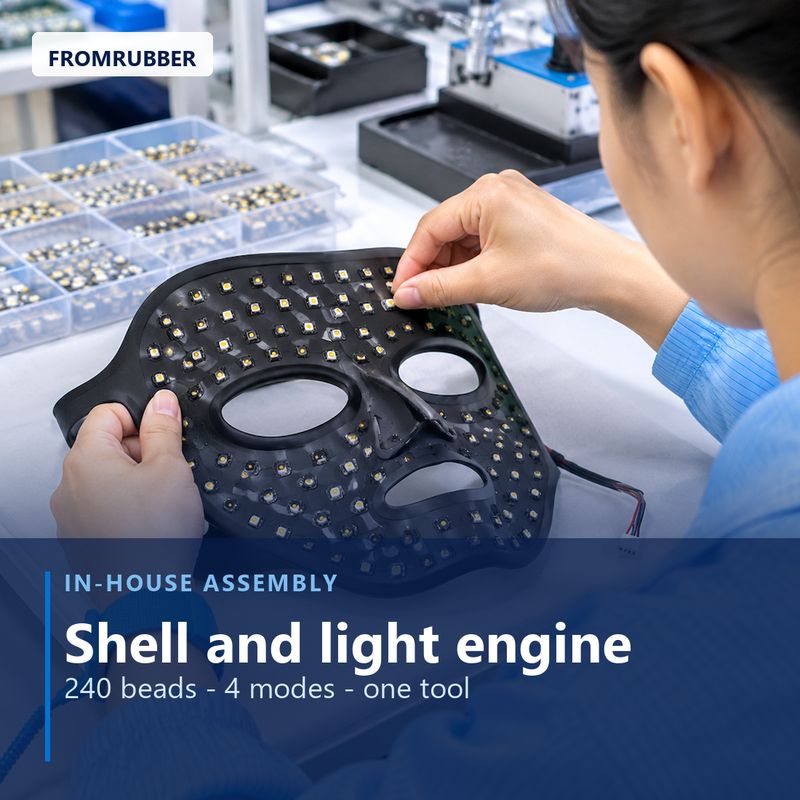
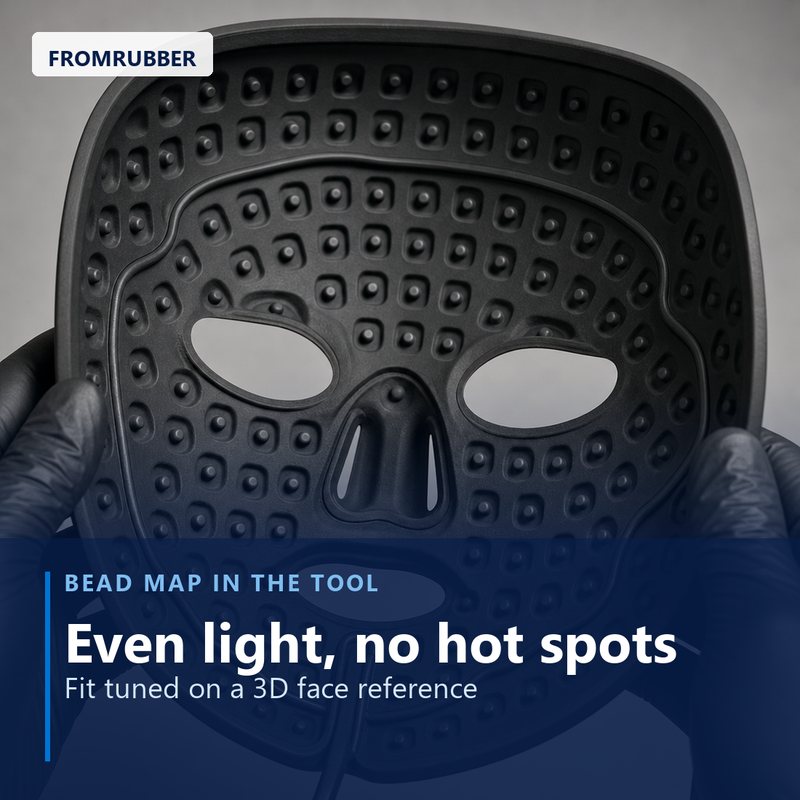
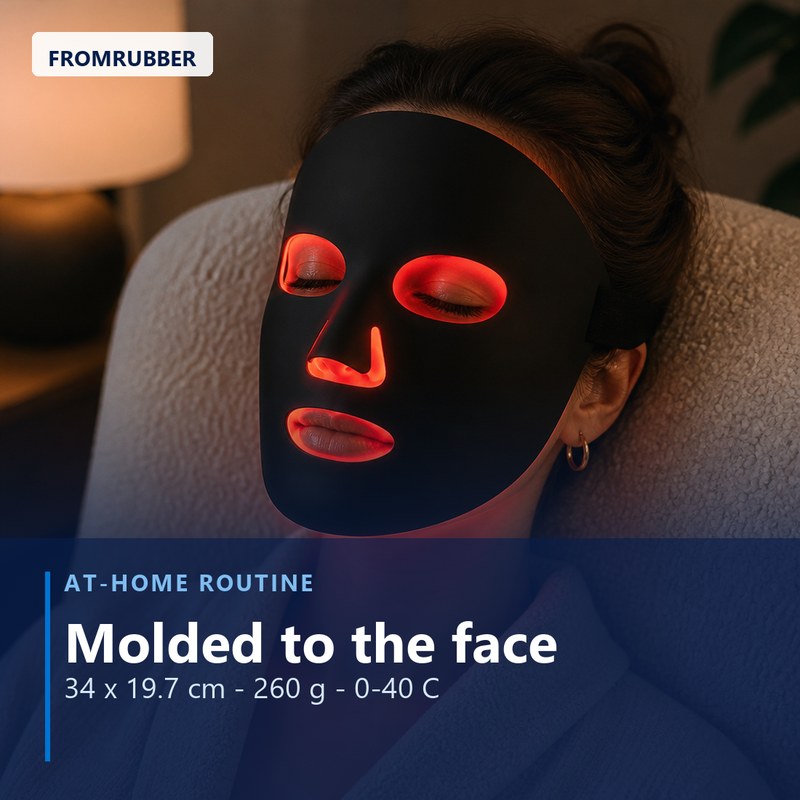
A silicone beauty mask is a flexible molded face shell that holds LEDs or a heating layer against the skin. FromRubber builds the 34 x 19.7 cm, 260 g shell and its 240-bead light module around a brand own electronics specification, so fit and light behavior can be tuned before tooling. The shell is molded to a face form rather than cut from sheet, so eye, nose and jaw openings can be positioned instead of approximated. Bead spacing across the forehead, cheeks and jaw is set in the tool, which is what keeps the effective dose even across the treated area. Red, blue, yellow and infrared channels share a single flexible carrier, with three intensity steps wired to the brand controller. Two masks can carry the same bead count and deliver visibly different results, because what matters is the distance and angle between each emitter and the skin. A molded shell holds that geometry; a flat pad collapses against the cheekbones and concentrates light where the material touches. The second variable is weight. At 260 g the assembly is light enough to stay on the face without a strap pulling at the ears, but heavy enough that the shell does not lift at the jaw when the wearer talks. Thickness distribution in the tool is how that balance is reached. A controlled gap between emitter and skin lets each bead cover its own area instead of forming hot spots. The gap is a tool dimension, not an assembly tolerance. Eye cut-outs and the outer rim are the two places light escapes toward the eyes. Rim thickness and a soft rolled edge are set together at the sample stage. LED heat has to travel into the shell rather than sit on the skin. Shell thickness under each bead and the ventilation path are reviewed with the electronics supplier. The base build below matches the current production shell. Electronics, wavelength mix and control strategy are supplied or specified by the brand. Cosmetic claims and the regulatory classification of the finished device stay with the brand owner. We build the shell and the light engine, and we document what we build. Electronics stay with your team; the molded interface is ours. Most beauty-device brands arrive with a controller, a battery strategy and a claim set, but without a shell that fits a real face. The clean split is: the brand owns electronics, firmware, claims and market registration; the factory owns the molded shell, bead placement, wiring routes and assembly tolerances. Keeping that boundary explicit shortens the project. The same platform also supports adjacent wearable silicone parts, which is useful when a brand wants a mask, a neck piece and a hand piece in one visual language, as shown in our <a href="https://www.fromrubber.com/products2132323/Custom-Silicone-Case.htm">custom silicone case</a> portfolio. Driver board, battery, charging port and mode logic remain with the brand or its electronics partner. Molded geometry, bead pockets, wiring channels, sealing and final assembly are controlled in-house. Electrical safety and cosmetic claim substantiation are planned by the brand for its own market; we supply material and process documentation. Tooling a face-worn shell is a fit problem before it is a molding problem, so the first two steps are about geometry rather than steel. A 3D scan or a physical reference head form sets eye spacing, nose bridge and jaw line, so the shell is designed against a real surface. The brand supplies the controller and bead specification, and the bead map is laid out against the face reference. A soft prototype is worn for comfort, light coverage and strap position before the production tool is cut. Shell molding, bead mounting, wiring and functional check run to the approved sample, with batch records kept. Yes. The skin-contact silicone can be wiped with a compatible disinfectant, but the electronics cavity must be sealed to whatever ingress level the brand specifies, and that seal is agreed before tooling. Yes, within limits. Eye spacing and jaw width can be varied with inserts, but radically different face forms usually need separate tools rather than one flexible shell. We supply material, process and assembly documentation. Electrical certification and cosmetic claim support are arranged by the brand for its target market, and we coordinate with its test lab where needed. Send your controller specification, bead count and target face size. We will return a shell concept, a bead map and a tooling plan before any steel is cut. Related capabilities: Custom silicone case · Multi-color silicone molding · Mold making
Silicone Beauty Mask Manufacturing: Fit, Light Path and OEM Control
Silicone Beauty Mask Fit Without Pressure Points
240-Bead Light Distribution in the Mask Shell
Four Wavelength Modes in One Silicone Mask
Why Shell Geometry Decides Light Uniformity and Comfort
Stand-Off and Beam Angle
Edge Seal and Light Leakage
Thermal Path at 0-40 C Operation
Silicone Beauty Mask Specification Envelope
Shell size 34 x 19.7 cm, molded face form Shell weight 260 g typical for the standard build Light source 240 LED beads across the shell Wavelength modes Red, blue, yellow and infrared Intensity steps 1-3 gears, controlled by the brand controller Operating temperature 0-40 C Working voltage 100-240 V, with the brand power supply Material Skin-contact silicone selected for the intended wear time
Shell and light engine, one supplier
The OEM Split: What the Factory Builds and What the Brand Owns
Electronics and Firmware
Shell, Optics and Assembly
Compliance Path
From Face Data to a Production Mask
Collect the Face Reference
Confirm Electronics and Bead Map
Prototype and Fit Trial
Production and Assembly
Silicone Beauty Mask Questions Brands Ask
Can the shell be cleaned between users?
Can the mask be sized for different face shapes?
Do you handle certification for the finished device?
Developing a Silicone LED Beauty Mask?