Fluid Sealing and Leak Prevention Rubber Washers for Plumbing
Item specifics
- Product name
- Rubber Washers
- material
- Silicone Rubber
- Color
- Black/white/custom
- Size
- base on your design
- Certification
- ISO9001/ISO14001
- Application
- Rubber Washers for Plumbing
Review
Description
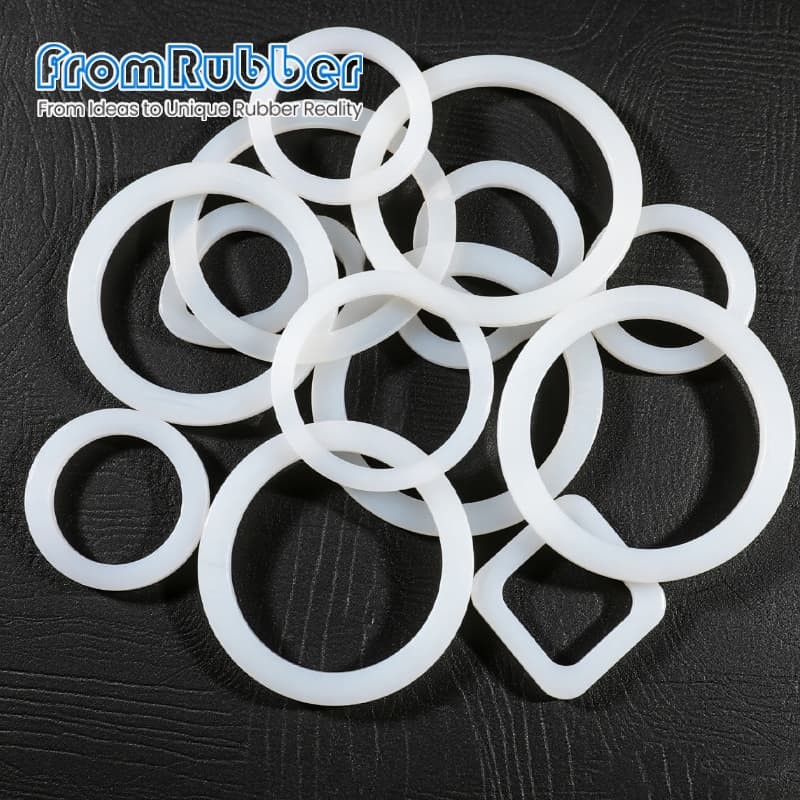
Fluid sealing A drip under a faucet is rarely a failed washer. It is usually a washer chosen for the wrong joint — too hard to conform to a scratched seat, too soft to hold torque, or a compound that swells in the medium. We mould and die-cut these to your fitting drawing in silicone, EPDM or NBR, for service from −60 °C to +200 °C depending on compound. Choosing between silicone, EPDM and NBR is not a preference question — each one has a medium it should never see. The table below is the short version we give to buyers who are consolidating a fitting range onto one compound and want to know where that will break. A washer seals because it is squeezed, not because it is soft. Three numbers decide whether it works: the compression ratio at the specified torque, the stiffness of the flange either side of it, and the width of the land the washer sits on. A thin soft washer on a stiff brass tailpiece will seal; the same washer on a plastic-bodied fitting will relax and weep within a season. Durometer choice for silicone washers — what each range does to compression set, torque retention and conformability — is set out in our guide to choosing the right hardness for a silicone washer. We keep this page on the joint: medium, temperature, seat condition and fitting standard. If the washer also has to isolate electrically or hold a tight stack height, the precision washer programme is the closer match. Pipe and valve connections, faucet and shower fittings, water pumps and filtration housings, industrial piping and pressure vessels, and heating or cooling circuit joints. The same geometry is often used across a family of fittings, which is why a single mould or die can cover a whole product range — worth checking before you assume a new tool is needed. Die-cutting is the right answer for flat washers in thin sheet, short runs and revises. Compression or injection moulding is the right answer once the section is profiled, the thickness is above a few millimetres, or the volume justifies a tool and you want the edge quality and dimensional consistency that come with it. We quote both and tell you where the crossover sits for your quantity. Both routes are inspected against ISO 3601 and ASTM D2000 methods, with hardness, tensile and a leakage simulation on the bench rather than a visual check alone. Food-contact and potable-water grades are available on request. The seat and the torque decide whether a washer seals. Send the fitting drawing or a sample and the reply is a compound plus a process recommendation, with the failure mode of the alternatives stated. Dongguan Bohao Electronic Technology Co., Ltd. IATF 16949:2016 / ISO 9001:2015 certified. Values shown are typical for the listed compound or platform; the drawing and the approved sample govern production.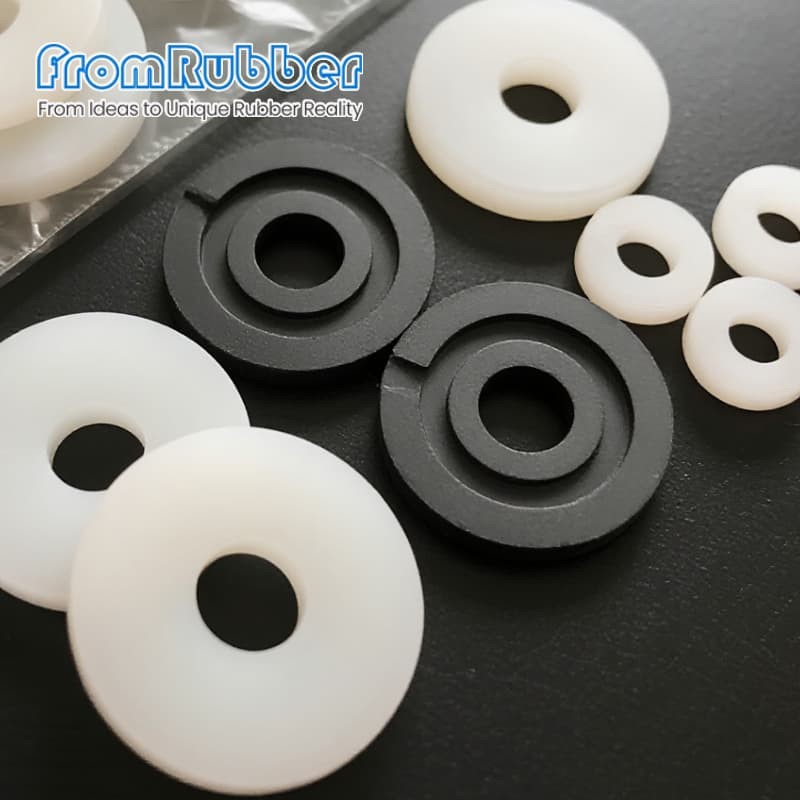
Washers for plumbing joints, specified by the joint and the medium
Three compounds, three failure modes
Compound What it gives you Typical plumbing use Where it is the wrong choice Silicone Wide temperature range, non-toxic, flexible at low temperature Drinking water systems, sanitary fittings Continuous contact with oils, fuels and some solvents EPDM Best weather, ozone and hot-water ageing of the three Outdoor plumbing, irrigation, hot-water joints Mineral oils, greases and hydrocarbon-based sealants NBR Oil and fuel resistance, good compression recovery Industrial piping, hydraulic and pump circuits Ozone, weathering and long dry outdoor exposure Sealing force is a compression question
Hardness selection has its own page
Where they actually go
Moulded or die-cut
What we need to quote
What comes back
Send the fitting, not just the dimensions
fromrubber.com
+86 18926836960