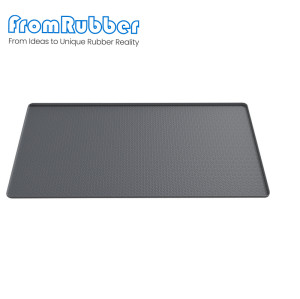
Compression Set in Elastomer Pads
A pad that takes a permanent set stops cushioning. Compound and crosslink density matter more than hardness alone.


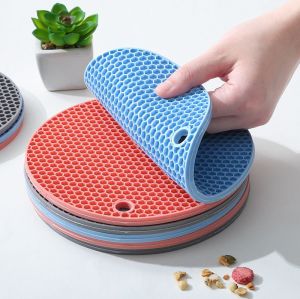
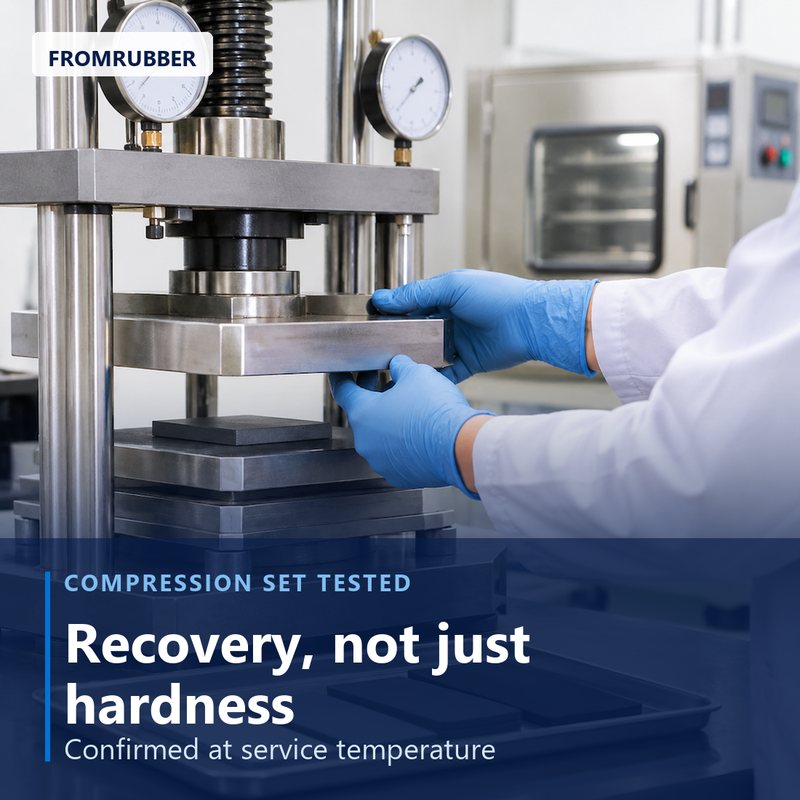
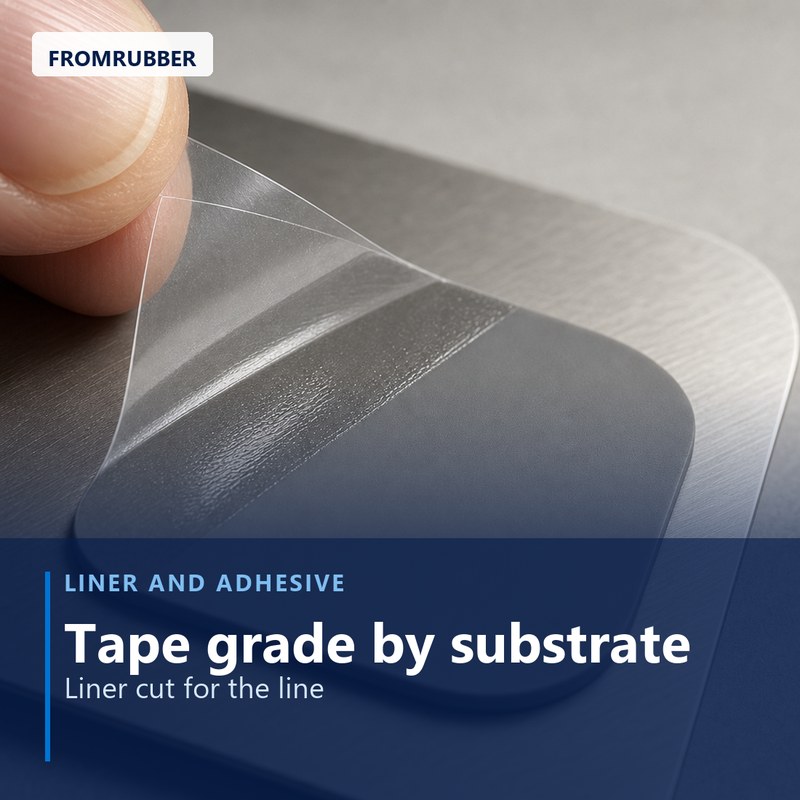
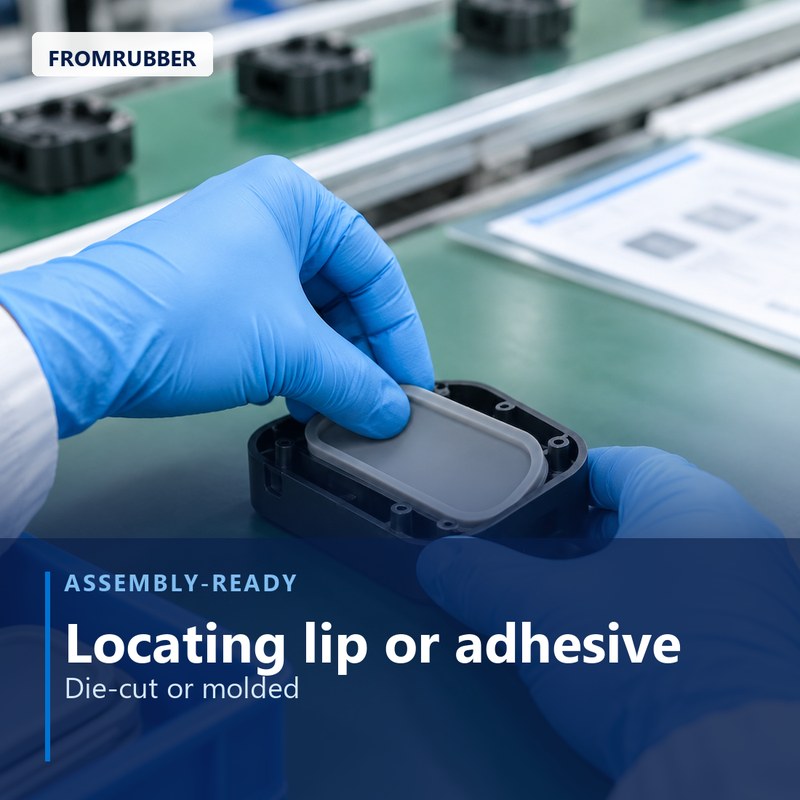
An elastomer pad is a molded or die-cut silicone part that separates, cushions or seals two surfaces in an assembly. Its performance is described by compression set, load deflection and thickness tolerance, not by color or shape. A pad that takes a permanent set stops cushioning. Compound and crosslink density matter more than hardness alone. Two pads at the same Shore A can deflect differently under the same load, because geometry and filler system differ. Pressure-sensitive adhesive, a molded locating lip or a mechanical retainer each solve a different assembly problem. Buyers often specify a pad by hardness and size, then discover that the part takes a set after a few weeks under load. Compression set is measured after a defined time at temperature and expressed as a percentage of the original deflection; it is the number that predicts whether a gasket still seals or a foot still cushions at the end of a product life. Deflection is the other half. A pad that is too soft bottoms out and transmits shock; one that is too hard does not conform and concentrates stress. For an OEM assembly the useful specification is a load-deflection curve at the service temperature, which is why we ask what the pad sits between rather than only how thick it should be. Set is measured under the actual service temperature and time, because a pad that recovers at room temperature may not recover in a warm enclosure. The curve shows how the pad behaves through its travel, which is what the enclosure design actually needs. A pad that is 0.2 mm over tolerance can preload a housing; one that is under can leave a gap. Tolerance is set against the stack, not against a default. Typical options for OEM pads, feet, spacers and cushioning layers. Final values follow the assembly load and the service environment. Compression set and load deflection are confirmed on the selected compound at the service temperature. A hardness number alone does not describe how a pad will behave in an assembly. Compression set predicts pad life better than hardness. Most pad failures are assembly failures. A pressure-sensitive backing bonds only to a clean, dry, reasonably smooth surface, and a pad applied over dust or mold release will detach before the adhesive is ever stressed. Surface preparation is part of the specification, not a line on a work instruction. Where the pad sits on a curved or flexible surface, a molded locating feature is more reliable than adhesive alone. For assemblies that are serviced, a mechanical retainer avoids the residue problem entirely. The <a href="https://www.fromrubber.com/products2132325/Silicone-Pad.htm">silicone pad</a> range covers molded, die-cut and adhesive-backed formats. Low-surface-energy plastics need a different adhesive from painted metal. The tape grade follows the substrate, not the catalog. Cleaning and dwell time are specified with the pad, because a correctly chosen adhesive still fails on a contaminated surface. A lip, pocket or pin removes the adhesive variable and makes the pad self-positioning on the line. The stack and the load define the pad; color and shape come last. What the pad sits between, the load it carries and the service temperature set the compound and the thickness. Prototypes are compressed in a fixture to check deflection, recovery and fit in the housing. Adhesive grade, liner and locating features are chosen against the substrate and the assembly method. Production runs to the approved compound and tolerance, with dimensional checks on thickness and outline. Silicone is the default for temperature range and compression recovery. Where oil resistance or abrasion resistance dominates, another elastomer is usually better, and we will say so rather than quote silicone for every pad. Yes. Adhesive can be applied to one face, both faces or as a tab, with the liner cut to suit manual or automated assembly. Simple die-cut pads can be sampled quickly because no tool is needed. Molded pads with locating features need a tool, so the sample timeline follows tooling rather than material. Send the stack drawing, load, service temperature and assembly method. We will propose a compound, a deflection target and a backing option. Related capabilities: Silicone pad range · Backing adhesive · Custom silicone parts
Elastomer Pads for OEM Assemblies: Compression Set and Cushioning
Compression Set in Elastomer Pads
Load Deflection, Not Just Hardness
Elastomer Pad Backing Options
Reading a Pad Specification: Compression Set and Deflection
Compression Set at Temperature
Load Deflection Curve
Thickness Tolerance
Elastomer Pad Specification Envelope
Material Silicone or specified elastomer Hardness Selected across the soft to medium range for the load case Thickness 0.5 mm and above, tolerance agreed per assembly Form Molded pad, die-cut sheet part or profile Backing Plain, pressure-sensitive adhesive, or molded locating feature Surface Smooth, textured or fabric-backed Color Standard colors and custom matching Documentation Material datasheet and dimensional report on request
Measured at service temperature
Backing and Assembly: Where Pads Actually Fail
Adhesive Selection by Substrate
Surface Preparation
Molded Locating Features
From Assembly Load to an Approved Pad
Define the Stack and Load
Prototype and Compress
Select the Backing
Produce and Inspect
Elastomer Pad Questions Engineers Ask
How do I choose between silicone and another elastomer?
Can the pad be supplied with adhesive on one side only?
What is a realistic sample lead time?
Specifying a Pad for an OEM Assembly?