Reliable Senior Rubber Parts for Heavy Machinery
- Model
- BH-parts
Item specifics
- Product Name
- Senior Rubber Parts
- Material
- Rubber
- Color
- Black,Custom
- Shape
- Custom
- Feature
- Reliable Senior
- Application
- Heavy Machinery
- Sales Method
- Molded Custom
- Consultation Email
- Suey@fromrubber.com
Review
Description
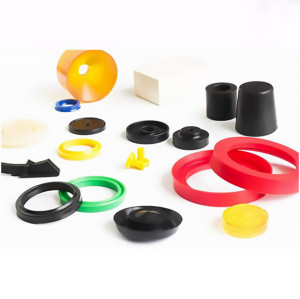
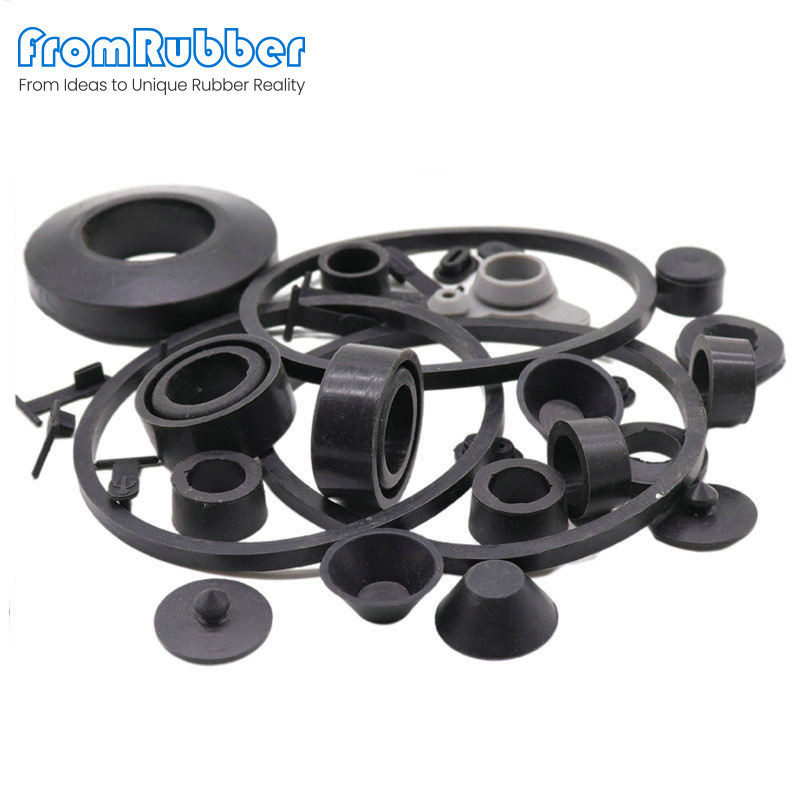
A seal that weeps on a 30-tonne excavator has usually passed its material test. It failed at the interface: the gland let the seal extrude, the rod finish was too rough to hold an oil film, or the compound took a permanent set at 110 C and stopped pushing back. When we reproduce a replacement part we start with the cavity and the duty cycle, not with the colour of the old seal. Rings and sections for hydraulic and dust-exclusion duty. Cross-section is derived from the cavity, not copied from a catalogue. Boot wall thickness and convolution spacing decide stroke life; both are visible in the section, not in the compound name. Five observations on a removed part identify the mechanism that was at work. The sixth item is the mistake that follows them. Selection of senior rubber parts starts with the fluid and the temperature band, then moves to mechanics. The right-hand column is where each material is normally the wrong answer. These are selection windows, not guarantees. Every compound is confirmed against its datasheet and an immersion test in the actual fluid before the part is released. Where the fluid is the dominant variable rather than the mechanics, the grade decision is covered separately on our FKM and FPM parts page. For thin-wall and undercut geometry on the same class of part, see undercuts and thin-wall structures. Small moulded parts carry the same risk as large ones: an unmarked batch cannot be traced to a compound lot. Caps and plugs are retention problems: a bead-and-groove location holds where a guessed interference eventually relaxes. The trial is short by design: two prototypes and one duty cycle are usually enough to separate a good section from a lucky one. Yes. We measure the groove or cavity, derive the cross-section from cavity volume and required squeeze, and mould two prototypes at different hardness. The drawing is issued after the field trial, so it describes a part that has already worked rather than a part that was copied. Usually one of three causes: the section was copied from the worn seal instead of the cavity, the hardness was raised to stop extrusion without checking the counterface, or the compound was selected for temperature and not for the actual fluid. Each shows a different wear signature, which is why the removed part is read before anything is ordered. A compound lot reference, cure date, hardness results per cavity and a dimensional report against the drawing. Compression set and immersion results are issued with the first article, and repeated on request per batch. Yes. Trial batches from a production tool are normal before a volume commitment, and they are moulded on the tool that will run the order so the trial reflects real cavity-to-cavity variation. For senior rubber parts we return a failure reading, the section we would cut from your cavity, a compound shortlist for the fluid, and a tooling quotation.Heavy-Machinery Rubber Parts Fail at the Interface, Not in the Compound

Reading a worn part correctly
Material windows for heavy-duty parts
Material Best at Where it fails Typical use NBR Mineral oil, grease, water-glycol Ozone and UV cracking; not for ketones or brake fluid Rod and piston seals, wipers on hydraulic cylinders HNBR Oil at higher temperature than NBR, with better mechanical strength Higher cost; narrower low-temperature flexibility High-pressure oil seals, engine and transmission duty FKM Heat plus aggressive oils, fuels and aromatic solvents Ketones, esters, amines and hot water; poor low-temperature behaviour High-temperature oil seals and fuel-system parts EPDM Water, steam, glycol, ozone and weather Swells badly in mineral oil and fuel Coolant seals, dust boots, weather strips VMQ silicone Wide temperature band and electrical insulation Poor tear and abrasion resistance; swells in some oils Static seals at temperature extremes, protective boots PU Abrasion and high pressure, wiper duty Hydrolyses in hot water; limited temperature ceiling Rod wipers and high-pressure piston seals Reverse engineering without a drawing
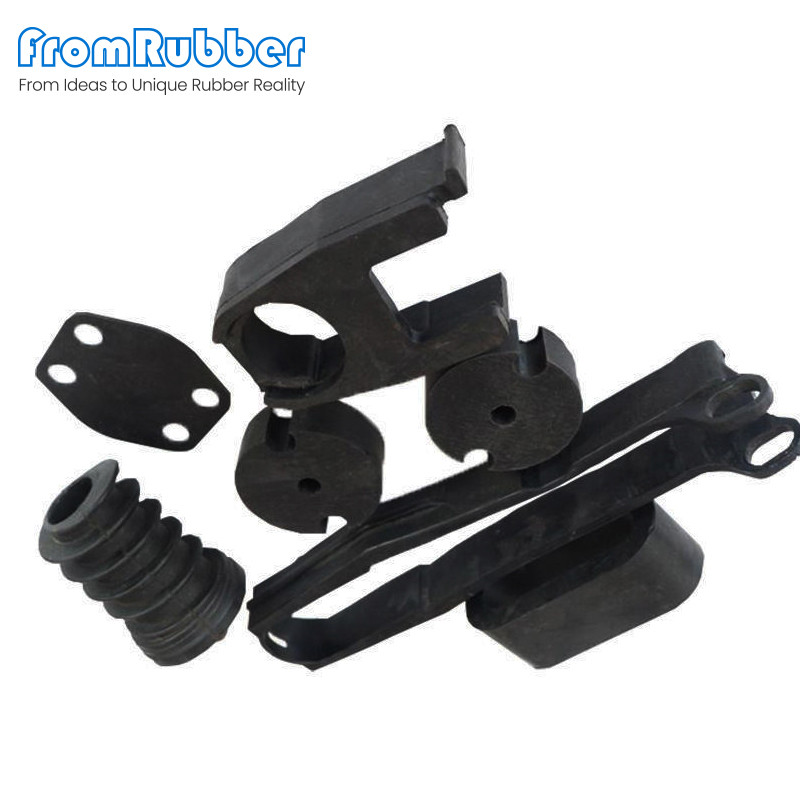

Boots, caps and mounts follow the same logic
From a failed part to a released batch
Questions from maintenance and design teams
Can you make a replacement part without a drawing?
Why do replacement seals leak in the first week?
Which documents ship with a production batch?
Do you produce trial quantities?
Send the failed part and the duty cycle