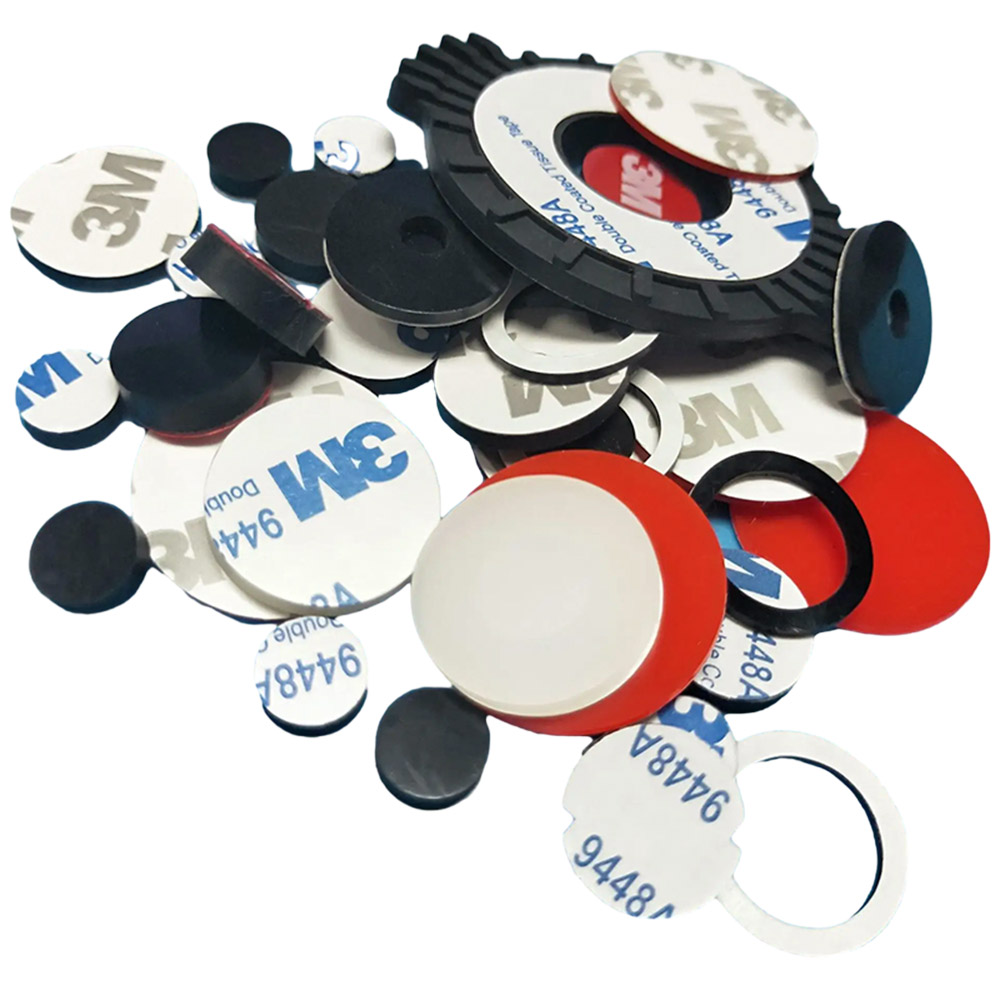
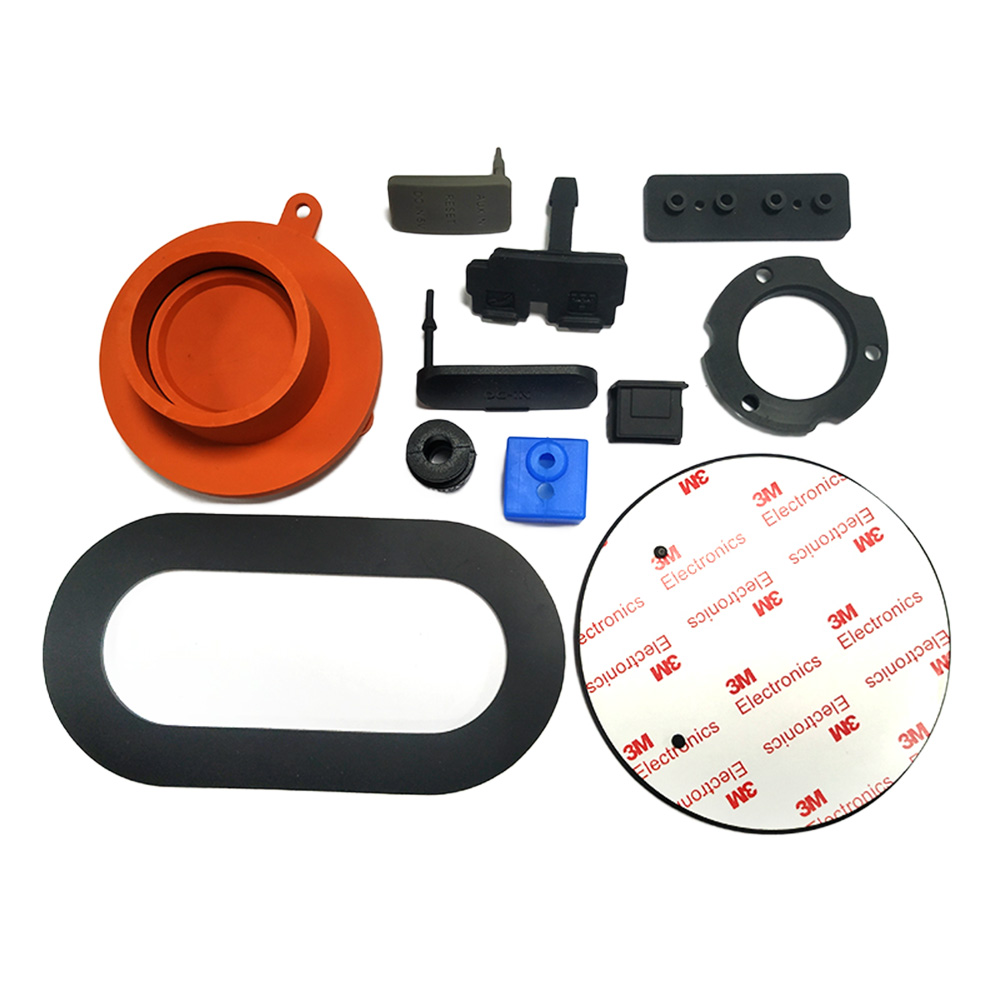
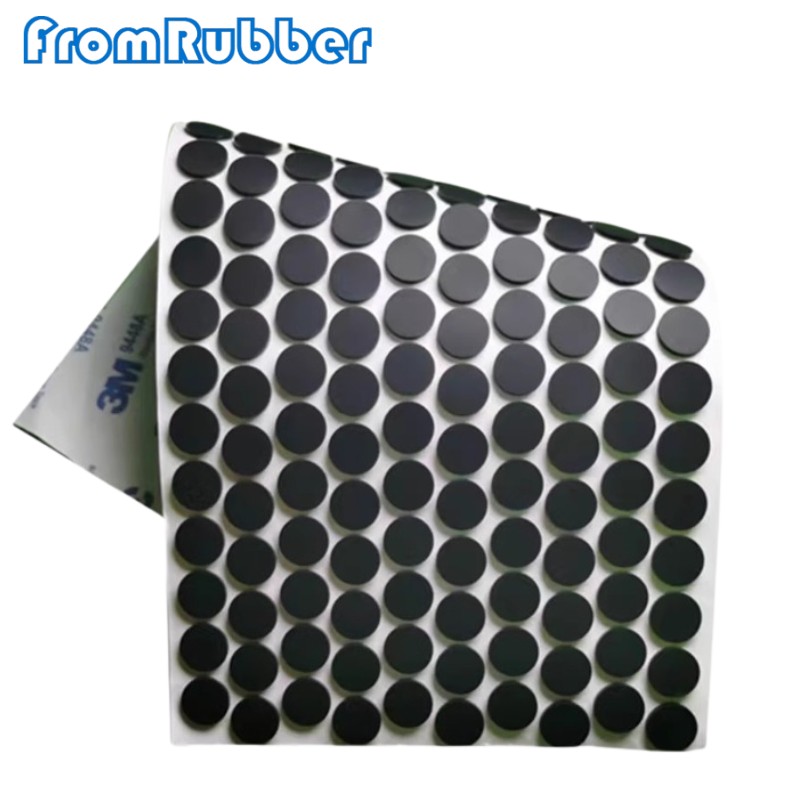
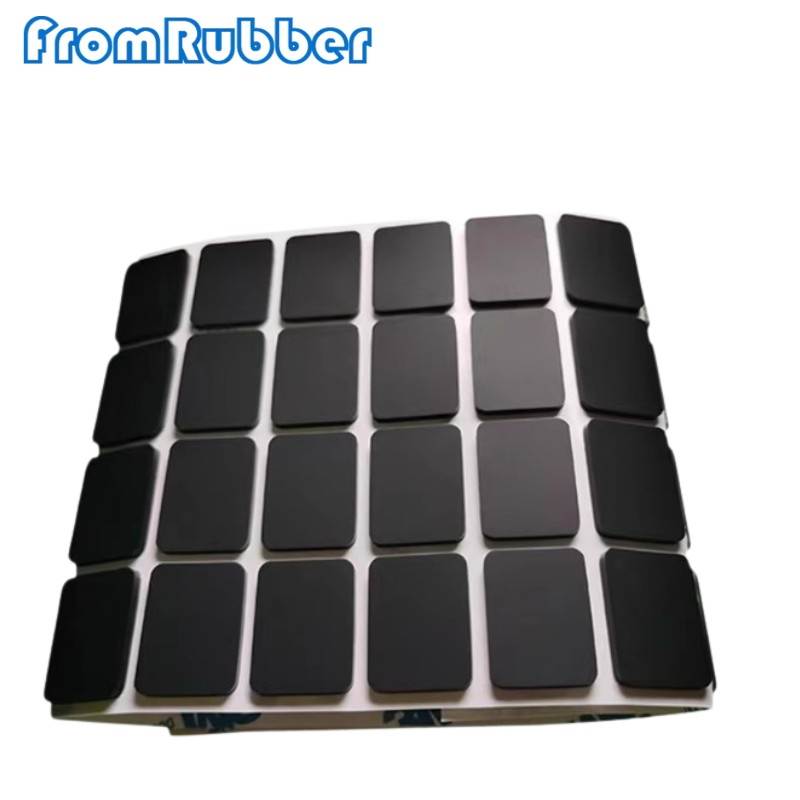
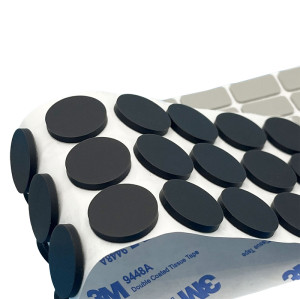
An adhesive silicone pad is a piece of silicone rubber with pressure-sensitive adhesive laminated to one face. It bonds to metal, plastic, glass, and painted surfaces without screws, clips, or mechanical fasteners, which is why it replaces loose hardware in electronics, appliances, machinery, and lighting assemblies.
Two things go wrong most often. The adhesive releases before the silicone wears out, usually because the tape was specified for the wrong substrate or the wrong service temperature. Or the die-cut tolerance is loose enough that the part sits proud, load concentrates on one corner, and the bond peels inward from the edge.
The bond fails first
Tape chosen for the wrong substrate or the wrong working temperature lets go long before the rubber is worn.
The fit fails first
Loose die-cut tolerance lifts one corner, concentrates load there, and the peel walks inward from that edge.
Both are controllable at the factory. What follows is the specification we hold, what can be changed, and what we need from your drawing to get it right the first time.
Silicone Pad Thickness, Hardness and Heat Range
The ranges below are standard. Anything outside them is engineered to order rather than refused. Send the application and we quote the closest workable combination.
Property
Standard range
Material
Silicone rubber, solid
Thickness
0.5 to 5 mm
Hardness
Shore A 30 to 70
Temperature resistance
-40 to 200 °C
Tensile strength
Up to 15 MPa
Elongation at break
Up to 600%
Adhesive
3M pressure-sensitive, single face
Surface finish
Smooth or textured
Color
Clear, black, red, or matched to sample
Dimensional tolerance
ISO 3302-1 M2
Shelf life
12 months, room temperature, low humidity
Read the temperature figure carefully
The silicone holds its elasticity to 200 °C. The adhesive does not. Acrylic tape is comfortable to roughly 90 °C continuous, so a pad running hotter than that needs a silicone-based adhesive even though the rubber itself is well inside range. Specify continuous working temperature, not peak, and the two stay matched.
Which Adhesive Survives Your Substrate?
Silicone is chemically inert. That is exactly why it makes a good seal, and exactly why pressure-sensitive tape will not hold to it without help. Untreated silicone and acrylic adhesive form a thermodynamically incompatible pair. The tape wets the surface, but the bond is only van der Waals contact. Water is small and strongly polar, so it creeps along that interface from the edge until the adhesive lifts.
So the question is not which tape is strongest. It is what this pad has to survive. Four variables decide it.
Substrate
Low-surface-energy plastics such as polypropylene and polyethylene need a high-tack acrylic or a primer. Bare aluminum and stainless bond readily. Powder-coated steel usually does not, because the coating itself becomes the weak layer.
Service temperature
Standard acrylic holds to about 90 °C continuous. Above that a silicone-based adhesive is required. The closer you run to the limit, the shorter the realistic service life of the bond.
Bond-line width
A narrow strip peels from its edges far sooner than a wide pad under the same load. Below about 5 mm wide, both the adhesive and the liner need to change.
Application
Pressure-sensitive adhesive does not set over time, it wets out under pressure. A pad pressed by hand onto a dusty surface will underperform the same pad rolled onto an IPA-wiped surface, every time.
We bond with 3M 9448A, 467MP, or 9080 depending on substrate and temperature. Every silicone face is primed before lamination with 3M Primer 94 or Shin-Etsu K-770, dried 3 to 5 minutes to graft an anchoring layer onto the surface.
1
Prime
Primer 94 or K-770 on the silicone face, dried 3 to 5 minutes.
2
Roll
Adhesive applied at a minimum of 3 kgf/cm² to expel micro-bubbles.
3
Cure
24 hours at 25 °C and 50% relative humidity before washing or peel testing.
A bond built that way survives 80 °C water for 2 hours without lifting. That sequence is the difference between a pad that stays on and a pad that comes back. If you already know the substrate and the working temperature, say so in the inquiry and we will name the adhesive before quoting.
Custom Shapes, Die-Cut to Your Drawing
Variable
Options
Size and shape
Any dimension, die-cut to your 2D drawing
Thickness
0.5 to 5 mm
Hardness
Shore A 30 to 70
Adhesive
3M acrylic, high-tack, or silicone-based
Adhesive coverage
Full face, perimeter only, or zoned
Liner
Standard release, or extended tab for line-side peeling
Surface
Smooth, textured, or embossed
Marking
Pad printing or laser marking of part number
Packaging
Bulk, sheeted, or individually bagged
Send a DXF, DWG, or PDF with dimensions, or a physical sample if the geometry resists description. We return a die drawing for approval before cutting steel, so tolerance callouts and material direction are agreed on paper rather than discovered at first article.
Lamination happens before cutting. Adhesive goes onto the silicone sheet under controlled pressure, then the die cuts both layers in one stroke. Cutting pre-laminated stock keeps the adhesive flush to the silicone edge, avoiding the lip that appears when tape is applied to parts that were already cut. The same service process covers sampling, tooling approval, and first article.
Where These Pads Are Used in Assembly
Electronics and appliances
Foot pads, internal cushioning, isolation under boards and speakers, gap filling between housing halves.
Automotive and HVAC
Anti-rattle bumpers, air-path gaskets, heat-resistant seals near lighting or exhaust-adjacent assemblies.
Medical and audio
Vibration damping where noise transmission matters, plus non-marking contact surfaces.
Industrial machinery
Anti-slip pads on control panels and enclosures, wear pads at contact points.
Furniture and packaging
Surface protection, scratch prevention, and noise reduction at impact points.
Lighting and displays
Heat-resistant spacers behind LED modules and diffuser panels, where acrylic tape would soften.
Pads that must also seal a joint are built as gaskets instead, with a different cross-section and a different inspection plan. Those are covered on our 3M adhesive silicone gasket page.
How Each Batch Is Checked
Hardness checked against the specified Shore A value
Thickness measured at several points across the sheet
Die-cut dimensions verified against the approved drawing
Peel check on the adhesive bond, with a retained sample per batch
A retained sample stays on file so a field failure can be traced back to the compound lot. This sits inside our wider silicone rubber parts range, which is produced under the same quality system. We work to ISO 9001 and ISO 14001. If your project needs a specific test standard or a report travelling with the shipment, raise it at quote stage, because it changes the inspection plan rather than just the paperwork.
Samples, Tooling and Lead Time
1 pc
Sample
Cut from stock thickness or from your drawing, so the design can be checked on the real assembly before tooling is committed.
3-5 days
Prototype mold
Built in our own mold shop rather than sent out, using the mold making capability that also serves production tooling.
10-12 days
Production tooling
Cut after the die drawing is approved, so tolerance callouts are settled before steel is committed.
3 hours
Quote
Send the drawing, the substrate, the continuous working temperature, and the quantity. The adhesive, hardness, and thickness come back named explicitly.
Terms are FOB Shenzhen, with L/C, D/A, D/P, T/T, Western Union, and MoneyGram accepted.
Compound, Tooling and Die-Cutting In-House
2factories
220staff
12,000 m²floor space
32molding machines
Compound, molds, and die-cutting all run in-house rather than through brokers. There are 7,254 molds on file and 6,532 custom projects developed to date, and every one of them sits inside the same custom silicone pad range.
What that changes for a buyer: a hardness change or an adhesive substitution is a production adjustment, not a new sourcing project. Die drawings come back in days rather than weeks. And when a part fails in the field, there is a batch record to trace it against.
Adhesive Silicone Pad FAQs
What are these pads made of?
Silicone rubber with a single-face pressure-sensitive adhesive. Standard colors are clear, black, and red, and hardness runs Shore A 30 to 70.
What is the maximum continuous operating temperature?
The silicone is rated to 200 °C. The adhesive is the limiting factor. Acrylic tape holds to about 90 °C continuous, and above that we switch to a silicone-based adhesive. Give us the working temperature and we confirm which applies.
How long does the adhesive actually hold?
It depends on substrate, temperature, and load, so a single number would mislead. Indoors on a clean, high-surface-energy substrate, a properly primed acrylic bond holds for years. Near the top of its temperature range, expect considerably less.
Can you die-cut to my drawing rather than a stock size?
Yes. That is the normal way these are built. Send a DXF, DWG, or PDF, or a physical sample.
What tolerance can you hold?
Die-cut dimensions follow ISO 3302-1 M2 unless your drawing specifies tighter. Thickness tolerance depends on the base sheet.
Do you supply bumper-shaped pads as well as flat sheet?
Yes. Domed, chamfered, and stepped profiles are molded rather than cut.
What is the minimum order quantity?
Samples start at 1 pc. Production volumes are quoted per project.
How should the surface be prepared before application?
Wipe with IPA and let it dry fully. Apply at room temperature with firm, even pressure across the whole pad, since pressure-sensitive adhesive wets out under pressure rather than over time. Avoid repositioning more than once, because each lift pulls contamination onto the adhesive.
Tell Us the Substrate. We'll Tell You Which Adhesive Holds.
Send a drawing, a sample, or a photo of the part you need to replace.
You get a quote within 3 hours, with the adhesive and hardness named.
Attachments up to 20 MB: PDF, DOC, XLS, JPG, PNG, GIF, ZIP, RAR.