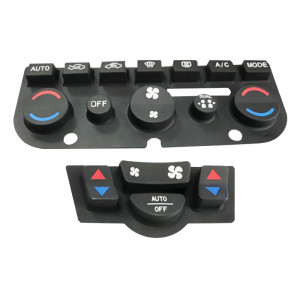
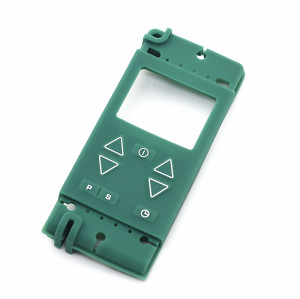
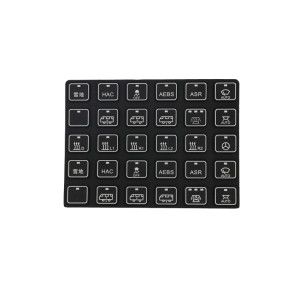
Silicone Overlay Panel Adhesive Backing Silicon Membrane Keypad
- Model
- BH-overlay panel
Item specifics
- Design
- Follow 3D Drawing Or Physical Object
- Process
- Molding
- Feature
- Button Matrix,Conductive,IP68 Rated
- MOQ
- 2000pcs
- Application
- industrial, medical & automotive applications
Review
Description
The adhesive under a silicone overlay panel carries three loads at once: it holds the panel down, it seals the perimeter against dust and liquid, and it resists the peel that starts every time someone lifts an edge. All three depend on the same three variables - the surface it is bonded to, the width of the bond, and how the part was applied. Which is why "adhesive backing" is not a specification. Two panels with the same tape on the same housing can behave completely differently if one is bonded to a flat moulded land and the other to a textured or painted surface. Not enough bond width. A narrow perimeter line concentrates the peel load. Width is a drawing dimension, not a default. Wrong surface. Low-energy plastics and powder-coated metals resist wet-out; the adhesive touches but does not anchor. Air trapped at lamination. A bubble becomes a lever. Under a warm housing it expands and lifts the edge above it. Thermal cycling. Overlay and housing expand differently. The bond has to absorb that movement, and a stiff adhesive eventually gives at the perimeter. ABS and polycarbonate are comparatively easy to bond. Polypropylene, polyethylene and many powder-coated or textured surfaces are not: the adhesive wets the surface but cannot form a strong interface, so the joint holds at first and creeps later. Painted surfaces add a layer whose own adhesion becomes the weak link. The practical sequence is: identify the actual substrate and its finish, clean it to a defined standard, then choose the adhesive. A primer can rescue a low-energy surface, but it adds a process step and has to be specified, not improvised on the line. "Clean" means free of mould release agent, oil and dust - not wiped with a solvent that leaves its own residue. Peel is not a function of total adhesive area; it is a function of the width of the line at the edge where the load is applied. Doubling the width of the perimeter bond helps roughly in proportion, while increasing the panel size without increasing the bond line does not. Three consequences for the drawing: state the bond width as a dimension with a tolerance; keep the bond line on a flat land, clear of texture, draft and parting lines; and break the perimeter into a continuous loop, because a gap of a few millimetres is where water and fingers will start. No interruptions at corners, cable exits or moulded features. A break in the loop is a start point for lifting. Texture and draft reduce the effective contact area, and a parting line under the bond is a leak path. A number on the drawing, verified on the first article with a peel test rather than by eye. Apply from one edge with a roller or a squeegee, in one direction, so air leaves ahead of the bond line. Keep the liner under tension and remove it at a shallow angle; pulling it back over the adhesive lifts the edge you have just laid. Then apply a defined dwell pressure, and let the bond sit before handling. A pressure-sensitive adhesive reaches most of its strength over hours, not seconds, so an assembly that is packed immediately will have been tested at its weakest. Choosing a backing tape and diagnosing peel failures is covered in why keypads detach and how to choose the backing adhesive; the same logic for sealing profiles is in adhesive backing for silicone gaskets. Once, at best, and never for a sealed panel. A pressure-sensitive adhesive that has been peeled has lost its wet-out; a re-applied panel leaks at the edge it was lifted from. Design service access around the panel instead. It conforms better to a slightly uneven surface, which can help on a textured land. It does not compensate for a low-energy substrate or a narrow bond line, so fix those first. Heat softens the adhesive and expands the trapped air, and the housing expands more than the overlay. That combination loads the edge, which is why the peel test belongs at the top of the service temperature range. Better to leave a smooth land under the bond and texture everything else. A texture that looks good on the outside reduces contact area exactly where the joint needs it. The adhesive cannot be chosen without knowing the substrate and how it is finished. Send the housing material, the surface treatment and the service temperature, and we will specify the backing plus the bond geometry to go with it.An overlay with adhesive backing is a joint with a service life, not a sticker
Four reasons an overlay lifts, in the order they happen
Peel starts at the edge
Surface energy decides which adhesive can work
Match the tape to the plastic
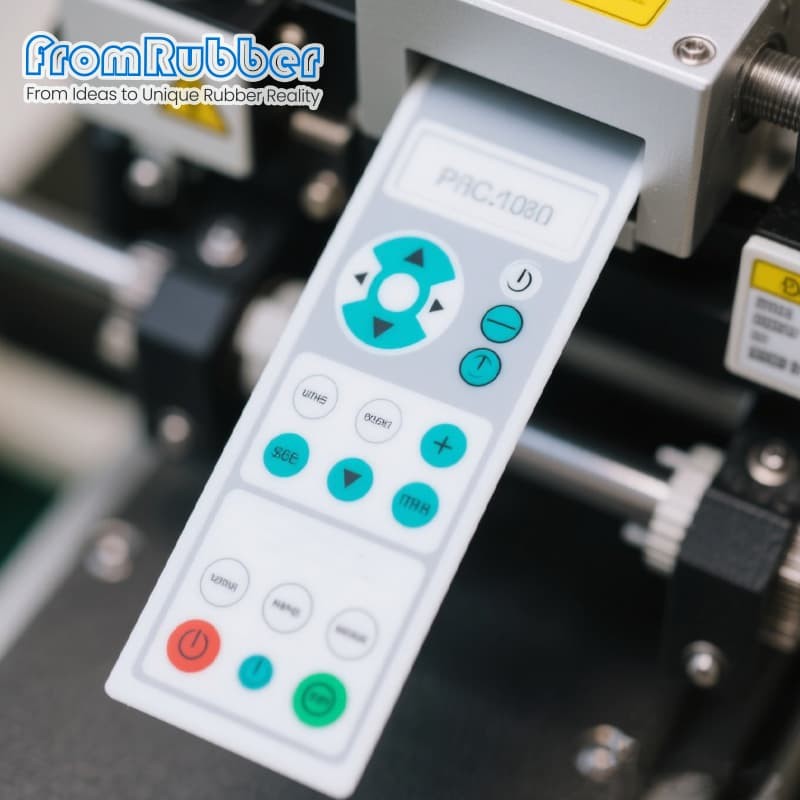
Bond width and peel load
Continuous loop
Flat land
Defined width
Applying it without bubbles
Lamination is a process, not a press
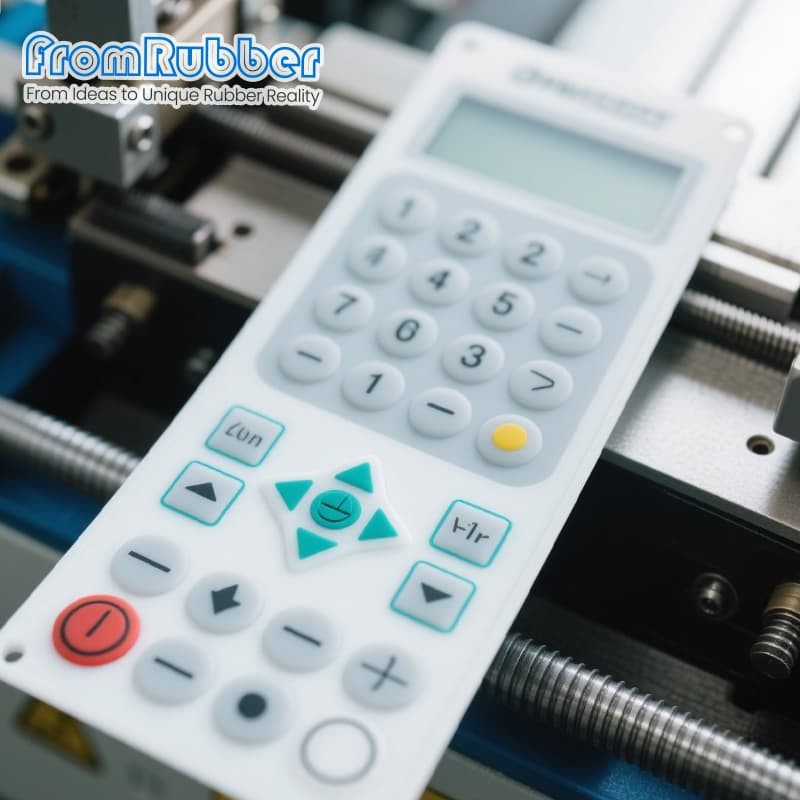
Specification on this series
Questions from mechanical and process engineers
Can the overlay be removed and re-applied?
Does a thicker adhesive bond better?
Why does the panel lift in summer but not in winter?
Can the housing be textured under the bond?
Send the housing material and its finish