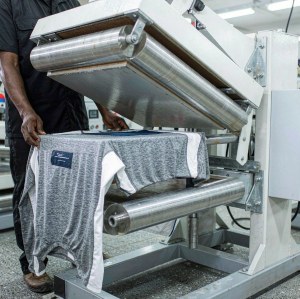
Washable Silicone Labels for Laundry & Fabric Products
- Model
- BH-silicone label
Item specifics
- Design
- Follow 3D Drawing Or Physical Object
- Process
- Molding
- Feature
- Safe, colorful, and washable
- MOQ
- 1000pcs
- Application
- Laundry & Fabric Products
Review
Description
A laundry label lives in a harder environment than most industrial parts: 60 to 90 degrees C, alkaline detergent, oxygen or chlorine bleach, high mechanical action, then a tunnel finisher or a tumble dryer. Silicone itself tolerates all of that. What fails in service is almost always the marking or the attachment, and both are decided at the drawing stage. So the useful question is not "is it washable" but "which marking, fixed which way, on which fabric, against which wash programme". This page answers that for uniforms, hotel linen, towels, aprons and home textiles, where the same label may see two hundred cycles before the garment is retired. Printed ink abrades against other garments in the drum. A moulded or laser-marked legend survives because the contrast is in the material, not on it. If the label carries a care instruction or a laundry ID, test legibility, not adhesion. Sewn labels fail at the stitch holes; heat-applied labels fail at the perimeter when the fabric finish resists the adhesive; adhesive-backed labels creep under heat. Choose the fixing by fabric, not by convenience. On stretch knits and elastic waistbands a stiff label puckers the fabric and peels at the ends. A thinner section and a smaller footprint usually outperform a stronger adhesive. The three marking routes are not interchangeable, and the choice changes both tooling and unit cost. Read across for the trade-off rather than for a ranking. A care-instruction label is a compliance document, not decoration. If the legend must stay legible for the life of the garment, specify a moulded or laser legend and state the wash programme it has to survive. State temperature, detergent type, bleach type and concentration, and the drying method. "Industrial wash" alone is not a specification. Test to the cycles the item will see, not to five. Uniforms and hotel linen are usually specified in tens or hundreds. Photograph the label at cycle 1, 10 and the final cycle and compare legibility, not just presence. Pull the edge at 90 degrees after the final cycle. A label that is intact but lifting has already failed in service. Look for puckering, shine or dye transfer around the label. A label that damages the garment is a defect even if the label survives. For the wider decoration context — including why silicone outlasts embroidery in repeated washing — see washable silicone patches versus embroidery. Brand-facing 3D labels are covered separately under embossed 3D logo labels. The silicone will. The marking may not, and that is where the specification has to be explicit: state the bleach type and concentration, and choose a moulded or laser legend over printed ink if bleach is in the programme. Sewn where the fabric is heavy, coated or likely to be repaired; heat-applied where the panel is flat and the finish is compatible. On workwear that is washed at high temperature, sewing is the more predictable of the two. Yes, within the resolution the process allows. Moulded characters need a minimum stroke width; a long serial number is better laser-marked than moulded. Send the character set and the reading distance. If the item is rented and re-labelled, specify a sewn label on a dedicated tab rather than a bonded one. Removal that damages the garment is the usual complaint in rental laundry. Marking method, attachment and section thickness follow from the wash programme, not from the catalogue. Send the care legend, the fabric and the cycle count, and we will propose a label that passes the test you actually run.Washable silicone labels: the wash chemistry decides the spec, not the word "washable"
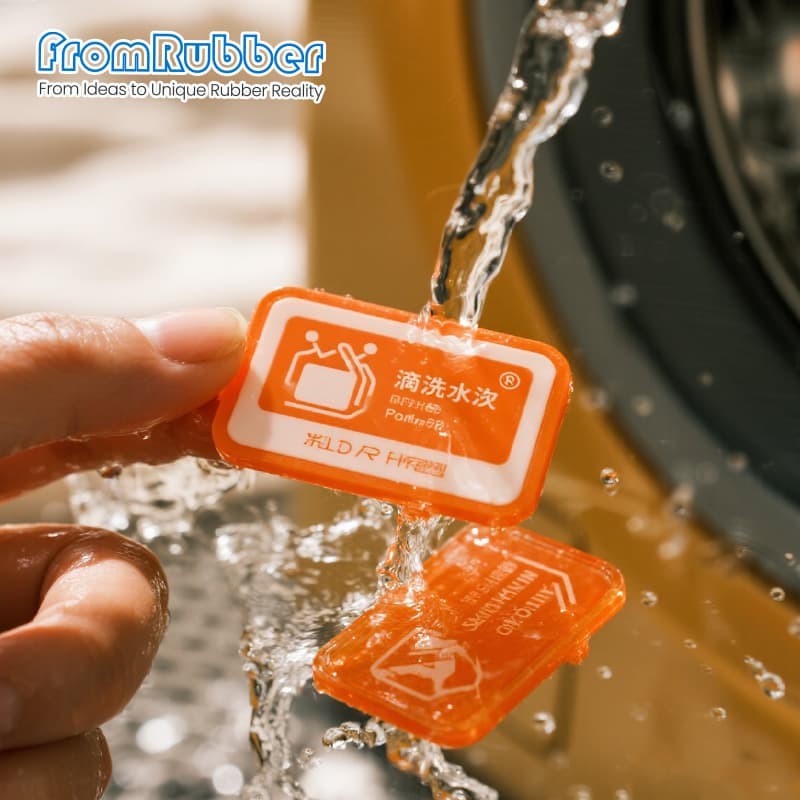
Three failure modes, three different fixes
Marking
The legend wears before the label does
Attachment
The edge lifts at cycle 30, not cycle 3
Substrate
The fabric moves, the label does not
Choose the marking method before the mould
Specification for a laundry programme
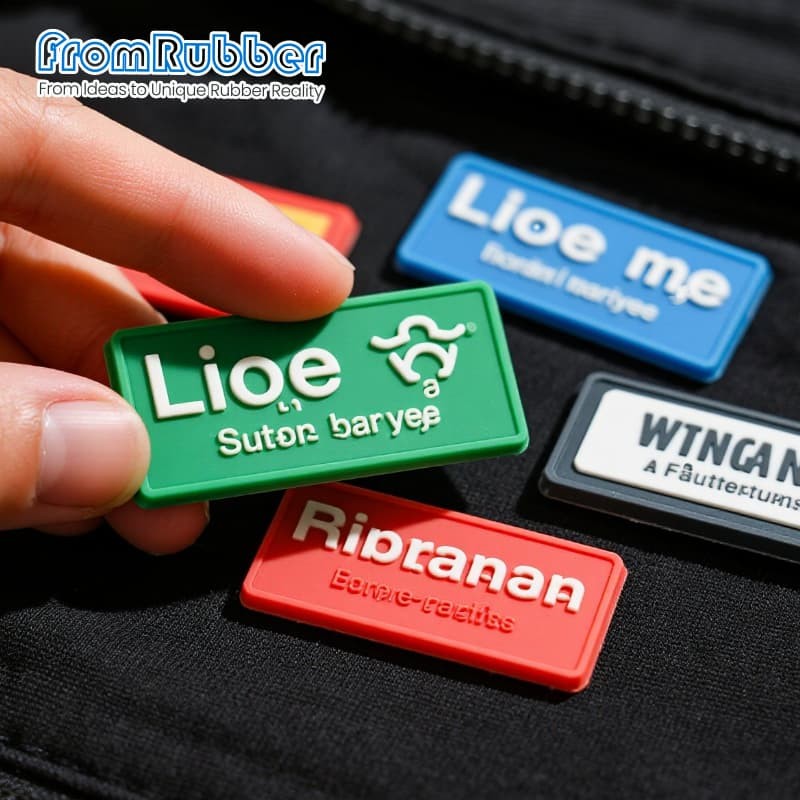
A wash protocol worth agreeing in writing
Fix the programme
Cycle to the real number
Read the legend each time
Check the fixing, not the label
Re-check the fabric
Questions from laundry operators and garment brands
Will the label survive chlorine bleach?
Sewn or heat-applied for uniforms?
Can the label carry a barcode or an ID number?
Does the label need to be removable?
Send the wash programme and the care text